

Summary
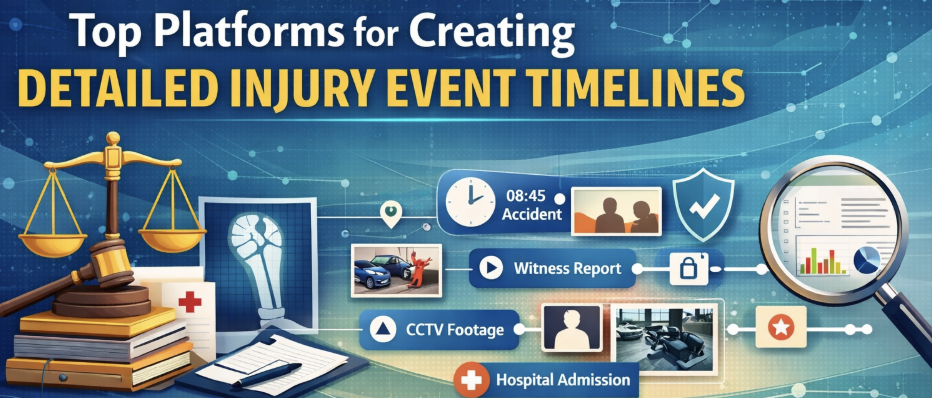
Creating accurate, defensible injury event timelines has become essential for legal, insurance, healthcare, and compliance teams managing complex cases. The top platforms for creating detailed injury event timelines combine structured chronology tools, document correlation, and secure collaboration to reduce errors and improve decision-making. This article compares the leading platforms, explains where each excels, and provides clear guidance on selecting the right solution.
Introduction
Injury cases often involve fragmented records, multiple stakeholders, and evolving narratives. Without a reliable way to reconstruct events, organisations face increased legal risk, delayed claims resolution, and weakened evidentiary integrity.
Top platforms for creating detailed injury event timelines are designed to solve this problem by transforming medical records, incident reports, witness statements, and communications into structured, defensible chronologies. In this article, you will learn how these platforms work, how they differ, and which solutions are best suited for professional use in 2026.
What Is an Injury Event Timeline Platform
An injury event timeline platform is specialised software that enables users to organise, analyse, and visualise events related to an injury or incident in strict chronological order.
These platforms typically support:
-
Medical and incident document ingestion
-
Time-stamped event reconstruction
-
Cross-referencing of evidence sources
-
Secure collaboration across teams
They are widely used in litigation support, insurance claims analysis, workplace investigations, and clinical risk management.
Why Accurate Injury Timelines Matter
Legal and Claims Accuracy
Inconsistent timelines weaken legal arguments and increase dispute risk. According to the American Bar Association, incomplete or poorly organised evidence remains a leading contributor to adverse litigation outcomes.
https://www.americanbar.org/groups/litigation/resources/newsletters/pretrial-practice-discovery/evidence-management-litigation/
Risk and Compliance Management
Healthcare and enterprise organisations must demonstrate traceability and documentation accuracy to meet regulatory standards such as GDPR and internal audit controls.
https://gdpr.eu/article-5-how-to-process-personal-data/
Operational Efficiency
Structured timelines reduce manual review time, minimise duplication, and allow faster case resolution across departments.
Evaluation Criteria Used in This Comparison
To identify the top platforms for creating detailed injury event timelines, the following criteria were applied:
-
Chronology accuracy and automation
-
Evidence linking and annotation depth
-
Security, privacy, and compliance controls
-
Collaboration and export capabilities
-
Suitability for professional and enterprise use
Comparison of Top Injury Event Timeline Platforms
| Platform | Core Strength | Best Use Case |
|---|---|---|
| CaseFleet | Visual legal timelines with document linking | Litigation and personal injury law firms |
| TimeMap | High-precision chronological mapping | Complex legal and forensic cases |
| CaseGuard | Multimedia evidence and transcript timelines | Incident investigations and disputes |
| ExhibitView | Evidence-driven chronology management | Insurance and claims professionals |
| Microsoft Power BI (Custom Models) | Customisable data-driven timelines | Enterprise analytics and compliance teams |
How to Interpret This Comparison
This comparison highlights that no single platform fits every organisation. Legal-first tools prioritise evidentiary precision, while enterprise platforms offer greater flexibility and integration. The right choice depends on regulatory exposure, collaboration needs, and data sensitivity.
Platform Reviews and Key Insights
CaseFleet
CaseFleet is widely used by litigation teams for building defensible timelines linked directly to source documents. Its structured event tagging and citation-first approach support legal scrutiny and trial preparation.
https://www.casefleet.com/
TimeMap
TimeMap is a long-standing chronology tool trusted in complex legal matters. It excels in managing dense event data and producing court-ready timelines but requires disciplined data input.
https://www.lexisnexis.com/en-us/products/timemap.page
CaseGuard
CaseGuard focuses on incident reconstruction using video, audio, and transcript timelines. It is particularly effective where injuries involve surveillance footage, recorded statements, or public-sector investigations.
https://caseguard.com/
ExhibitView
ExhibitView is purpose-built for insurance and claims professionals who need clear, defensible event sequences tied to evidence and reporting workflows.
https://exhibitview.net/
Microsoft Power BI (Custom Implementations)
While not a dedicated injury timeline tool, Power BI is often used by enterprises to create controlled, audit-ready timelines from structured datasets when paired with strong governance and data modelling.
https://learn.microsoft.com/power-bi/
Security, Privacy, and Data Protection Considerations
Injury event timelines often contain sensitive personal and medical data. Leading platforms implement:
-
Role-based access controls
-
Encrypted data storage and transmission
-
Audit trails and activity logs
-
GDPR-aligned data handling practices
Organisations should always validate vendor security documentation and data residency policies before implementation.
Actionable Recommendations
To select the right platform for creating detailed injury event timelines:
-
Define your primary risk – litigation exposure, regulatory compliance, or operational efficiency.
-
Map your data sources – medical records, reports, multimedia, or structured databases.
-
Prioritise defensibility – ensure timelines can be audited, exported, and verified.
-
Pilot before scaling – test with a real case to assess usability and accuracy.
Clear evaluation upfront prevents costly rework later.
Frequently Asked Questions
What is the best platform for personal injury law firms
CaseFleet and TimeMap are commonly preferred due to their legal-grade citation and chronology features.
Are injury event timeline platforms GDPR compliant
Most leading platforms offer GDPR-aligned controls, but compliance depends on correct configuration and internal governance.
Can these tools replace manual case review
They reduce manual effort significantly but should complement, not replace, professional judgement.
Do enterprise teams need specialised tools
Not always. Some organisations successfully use analytics platforms like Power BI with strict data controls.
Conclusion
Top platforms for creating detailed injury event timelines have evolved into essential infrastructure for organisations managing complex incidents and claims. By combining structured chronology, evidence linkage, and secure collaboration, these tools improve accuracy, reduce risk, and strengthen decision-making. Choosing the right platform requires aligning technical capability with legal, regulatory, and operational realities.
