

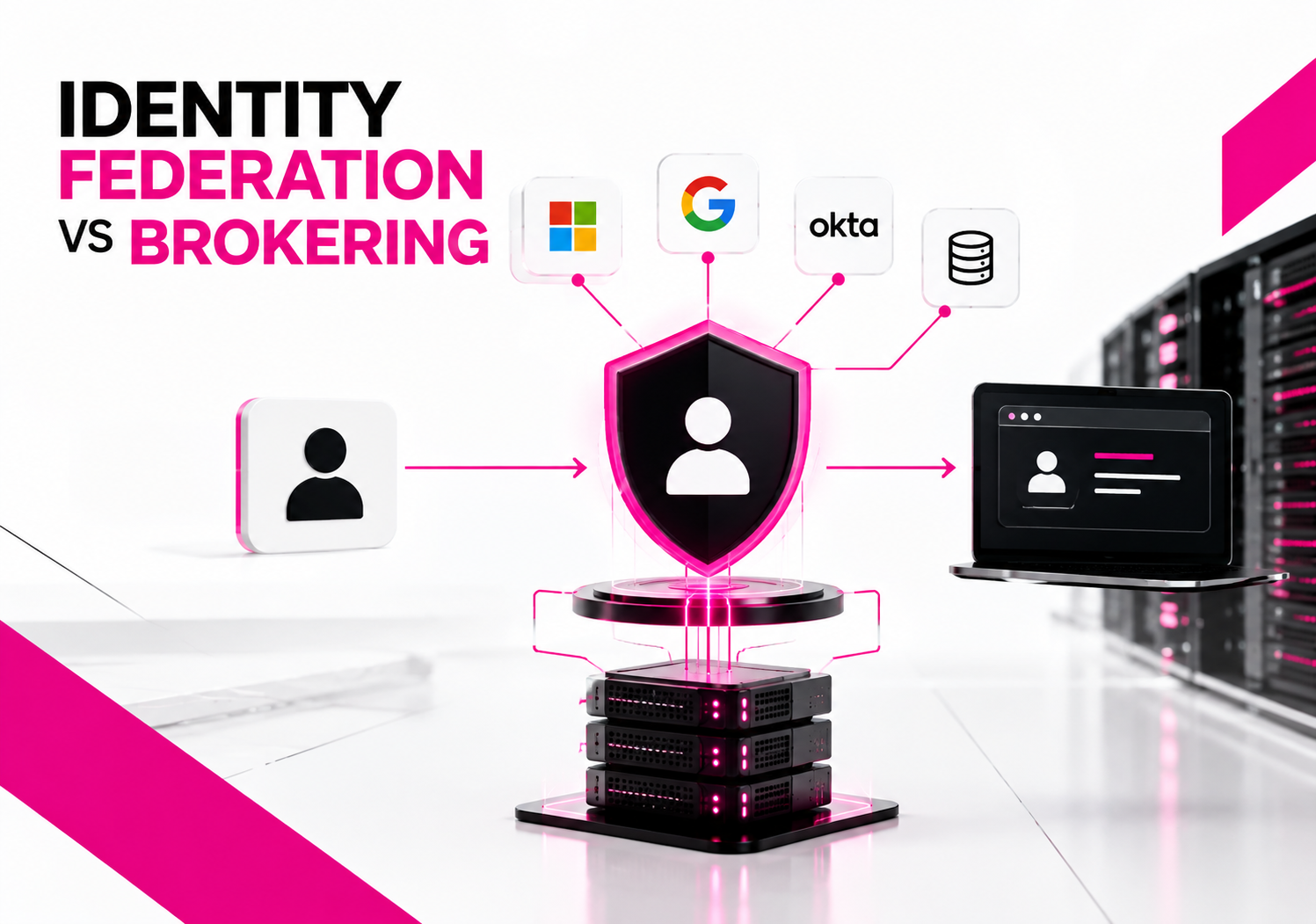
Identity federation is the trust model that lets one identity provider authenticate users for another application or organization, while identity brokering adds an intermediary that connects multiple identity providers to relying applications. Federation defines the trust relationship; brokering manages or translates those relationships through a central intermediary. In practice, an identity broker often implements federated authentication rather than replacing it.
The terms are often used interchangeably, which creates confusion when designing IAM architecture. They are related, but they describe different architectural concepts.
NIST’s current Digital Identity Guidelines, SP 800-63C-4, defines federation around the exchange of authentication and subscriber attributes between separately administered parties. NIST also describes a federation proxy as an intermediary that effectively operates as an identity provider on one side and a relying party on the other.
That distinction is the key to understanding identity federation vs identity brokering: federation establishes and carries trust across domains; brokering provides a central connection point between identities, protocols, and applications.
What is identity federation?
Identity federation allows an application or relying party to trust authentication performed by an external identity provider instead of managing the user’s credentials itself. The identity provider authenticates the user and sends an assertion or token containing relevant authentication and identity information to the relying party.
A simple example is an employee signing into a SaaS application with a corporate Microsoft Entra ID account.
The SaaS application does not need to maintain the employee’s corporate password. Instead, it trusts the organization’s identity provider to authenticate the employee.
The basic relationship is:
User → Identity Provider → Application
Common federation technologies include:
- SAML 2.0
- OpenID Connect
- OAuth-based identity architectures
- WS-Federation in older enterprise environments
OpenID Connect, for example, adds an identity layer on top of OAuth 2.0 and allows a client to verify an end user’s identity through an OpenID Provider and receive identity claims.
NIST’s current guidance explicitly recognizes federation as a mechanism through which a credential service provider can provide authentication and subscriber attributes to separately administered relying parties.
What is identity brokering?
Identity brokering places an intermediary between applications and one or more external identity providers. The broker accepts authentication from an upstream identity provider and presents the appropriate identity or assertion to a downstream application.
Instead of every application integrating separately with Google, Microsoft Entra ID, Okta, an enterprise SAML provider, and other identity sources, the applications can integrate with one broker.
The architecture becomes:
User → Identity Provider → Identity Broker → Application
A broker can also let the user choose an identity provider:
User → Broker → Microsoft / Google / Okta / Partner IdP → Broker → Application
Keycloak is a common example. Its documentation describes an identity broker as an intermediary connecting service providers with identity providers. Keycloak can integrate external identity providers using protocols including SAML 2.0 and OpenID Connect.
The broker therefore becomes a central integration and policy point.
Identity federation vs identity brokering: what is the difference?
Federation describes the trust relationship and exchange of authentication information; brokering describes an intermediary architecture used to connect identity providers and relying parties. They are not mutually exclusive technologies.
| Identity federation | Identity brokering |
|---|---|
| Defines trust between identity domains | Adds an intermediary between parties |
| IdP authenticates for an RP | Broker connects upstream IdPs to downstream apps |
| Often direct IdP-to-application trust | Applications can trust the broker |
| Common with SAML and OIDC | Common with IAM platforms and gateways |
This is why asking which one is “better” can be misleading.
You can have federation without a broker.
You can also have a broker that participates in federated authentication.
NIST explicitly describes proxied federation in which a third party acts as a federation proxy or broker. The proxy can simplify integration by giving relying parties and identity providers a common interface.
Is identity brokering a type of federation?
Often, yes, but identity brokering and federation should not be treated as exact synonyms. A broker can participate in a federated authentication transaction while adding an intermediary layer between the upstream identity provider and downstream application.
NIST’s terminology is useful here. In a proxied federation, the proxy operates as an IdP toward the relying party and as an RP toward the upstream IdP.
That means a broker effectively translates the trust relationship:
Upstream IdP → Broker → Downstream RP
The broker may:
- Authenticate through an external IdP
- Translate SAML to OIDC or another supported protocol
- Normalize identity attributes
- Map groups and roles
- Select the correct upstream IdP
- Apply broker-level policies
- Provide a consistent integration point for applications
This is why identity brokering becomes especially valuable when an organization has many identity sources.
Why use identity federation?
Federation is most useful when an application needs to trust an identity managed by another security domain. It reduces the need to create and maintain separate application passwords and allows the identity provider to remain responsible for authentication.
Consider a company buying a SaaS platform.
Without federation:
Employee → SaaS username/password
With federation:
Employee → Corporate IdP → SaaS application
The second model can centralize authentication controls such as MFA and account lifecycle management.
If an employee leaves the organization, disabling the corporate identity can prevent further federated authentication to connected applications, assuming provisioning, sessions, and application authorization are configured appropriately.
Federation also supports organizational relationships. A supplier, university, government agency, or business partner can allow users from another identity domain to access selected applications without creating a completely separate credential system.
Why use an identity broker?
An identity broker is particularly useful when many applications need to support multiple identity providers without building a separate integration for every combination.
Imagine an organization with:
- Microsoft Entra ID for employees
- Google Workspace for contractors
- An external partner using Okta
- A customer identity provider using SAML
- Several applications requiring OpenID Connect
Without a broker, every application may need multiple integrations.
With a broker:
Application → Broker → Multiple IdPs
The application can integrate primarily with the broker.
Keycloak documents this model directly: applications can redirect users to Keycloak, which presents configured identity providers and sends the user to the selected provider for authentication.
That can dramatically simplify application-side identity integration.
What are the security differences between federation and brokering?
Federation concentrates security around the trust relationship between identity providers and relying parties, while brokering introduces another security-critical component that must be protected and monitored.
Federation risks include:
- Incorrect trust configuration
- Weak token validation
- Excessive claims
- Misconfigured redirect URIs
- Certificate or signing-key problems
- Poor lifecycle management
- Overly broad application permissions
A broker adds additional concerns:
- Broker compromise
- Incorrect identity mapping
- Attribute transformation errors
- Token translation weaknesses
- Centralized outage risk
- Excessive broker privileges
- Misconfigured upstream providers
The broker therefore simplifies integration but becomes an important part of the authentication path.
If an attacker compromises the broker, the impact can extend across many applications and identity providers.
For OAuth-based implementations, the IETF’s RFC 9700 defines current security best practices and addresses threats involving authorization flows, redirect URIs, tokens, and related OAuth deployments.
The practical lesson is straightforward: centralization improves manageability, but it also increases the importance of protecting the central component.
Which is better for single sign-on?
Federation is the underlying mechanism commonly used for SSO across security domains, while a broker can make multi-provider SSO easier to manage.
For example, a company with one identity provider and 30 SaaS applications may simply configure direct federation:
Entra ID → SaaS applications
Adding a broker might be unnecessary.
But if the company has several identity providers:
Entra ID →
Google → Broker → SaaS applications
Okta →
the broker becomes much more useful.
The right choice depends on identity-provider complexity, application count, protocol requirements, and organizational boundaries.
Does an identity broker replace an identity provider?
No. An identity broker does not necessarily replace the upstream identity provider; it commonly connects applications to one or more existing identity providers.
A broker can act as an intermediary and may issue its own assertion or token toward the application.
From the application’s perspective, the broker may appear to be the identity provider.
From the broker’s perspective, however, it can be consuming authentication from an upstream provider.
This dual role is precisely what NIST describes for federation proxies: the proxy acts as an RP toward the upstream IdP and as an IdP toward the downstream RP.
Can an identity broker translate SAML to OIDC?
Yes, an identity broker can provide protocol translation between identity providers and applications when the broker supports both protocols. This is one of the most useful reasons to introduce a broker.
For example:
Corporate IdP → SAML → Broker → OIDC → Modern application
The application does not need to implement the corporate provider’s SAML integration directly.
This is particularly useful during identity modernization, where older enterprise applications may still rely on SAML while newer applications prefer OpenID Connect.
Keycloak, for example, supports external identity providers based on SAML 2.0 and OpenID Connect.
Protocol translation does not eliminate security requirements. The broker still needs to validate upstream authentication correctly, map claims safely, protect signing keys, and issue appropriate downstream tokens.
What are the privacy implications?
A broker can improve privacy in some federation architectures because it can act as an intermediary rather than exposing every direct relationship between an identity provider and application. NIST specifically identifies privacy and business-confidentiality benefits as possible advantages of federation proxies.
For example, a broker can prevent an application from needing a direct integration with every upstream identity provider.
But centralization also creates a valuable source of identity information.
A broker may see:
- Login events
- User identifiers
- Identity-provider selection
- Application access
- Authentication metadata
- Claims
- Session information
That makes logging, retention, access control, and data minimization important.
NIST’s current federation guidance includes privacy considerations alongside federation requirements, so privacy should be treated as an architectural requirement rather than an afterthought.
When should you use direct identity federation?
Use direct federation when you have a relatively simple trust model and applications can directly integrate with your organization’s identity provider.
Direct federation is usually the cleaner option when:
- You have one primary IdP.
- Applications support your preferred protocol.
- You control both sides of the trust relationship.
- You do not need protocol translation.
- There are relatively few identity domains.
- Central brokering would add unnecessary infrastructure.
Example:
Microsoft Entra ID → Microsoft 365 / SaaS / internal applications
There is little reason to introduce another identity layer if the existing IdP already provides the required authentication, authorization, lifecycle, and security controls.
When should you use identity brokering?
Use identity brokering when multiple identity providers, protocols, organizations, or application environments make direct federation difficult to manage.
A broker is a strong fit when you need:
- Multiple upstream IdPs
- SAML-to-OIDC translation
- OIDC-to-SAML integration
- Central identity-provider selection
- Consistent claim mapping
- Partner identity integration
- A common authentication interface
- Centralized federation policy
A customer identity platform is another common use case. Different customers may have their own enterprise IdPs, while your application wants one consistent authentication interface.
The broker can become the boundary between your application and those external identity systems.
How should you choose between federation and brokering?
Start with the number of identity domains and protocols you actually need to support. If one IdP can directly serve your applications, direct federation is usually simpler; if multiple IdPs and protocols are creating integration complexity, brokering becomes more attractive.
| Situation | Better approach |
|---|---|
| One main IdP + compatible applications | Direct federation |
| Multiple IdPs + many applications | Identity broker |
| Mixed SAML and OIDC requirements | Broker often helps |
Do not deploy a broker simply because it sounds more sophisticated.
Every additional identity component creates another system that must be patched, monitored, backed up, configured, and secured.
How do you implement identity federation securely?
Treat federation as a trust relationship, not just a login button. Start by defining exactly which identity provider is trusted, which applications can consume its assertions, which claims are released, and what authentication assurance the application requires.
A practical checklist:
1. Define the trust relationship
Document:
- Issuer
- Audience
- Redirect URIs
- Signing keys
- Metadata endpoints
- Allowed applications
- Required claims
2. Use modern protocols where appropriate
For modern web applications, OpenID Connect is commonly preferable to building a proprietary identity mechanism. OpenID Connect defines how clients obtain and validate identity information from an OpenID Provider.
3. Minimize claims
Only send the identity attributes the application actually needs.
Do not expose an entire directory profile when the application only requires a stable identifier, email address, and group information.
4. Validate tokens correctly
Check the issuer, audience, signature, expiration, and other protocol requirements rather than simply trusting a decoded JWT.
5. Protect redirect-based flows
For OAuth and OIDC implementations, follow current IETF security guidance. RFC 9700 specifically requires exact redirect URI matching in relevant authorization-server configurations and addresses several common OAuth attack classes.
6. Monitor authentication events
Track:
- Failed authentication
- New IdP integrations
- Configuration changes
- Signing-key changes
- Privilege changes
- Unusual authentication patterns
How do you secure an identity broker?
Secure the broker like a Tier-0 or otherwise highly critical identity service when it sits on the authentication path for many applications.
At minimum:
- Enforce strong administrator authentication.
- Restrict administrative access.
- Apply least privilege.
- Protect signing and encryption keys.
- Patch the broker promptly.
- Monitor configuration changes.
- Log authentication events.
- Protect management interfaces.
- Test failover and recovery.
- Review connected identity providers regularly.
- Remove unused integrations.
- Minimize stored identity information.
If the broker can issue tokens accepted by dozens of applications, compromise of that broker can have a broad blast radius.
The security model should therefore assume that the broker itself is a high-value target.
Is identity federation or identity brokering better for Zero Trust?
Neither is automatically a Zero Trust architecture, but both can support Zero Trust when identity is used for explicit, context-aware access decisions.
NIST’s Zero Trust model emphasizes removing implicit trust based on network location and making access decisions around users, devices, resources, and policies.
Federation can provide a trusted identity signal to an application.
Brokering can centralize and normalize that identity signal across multiple providers.
Neither automatically answers:
- Is the device healthy?
- Is MFA phishing-resistant?
- Is the requested resource sensitive?
- Is the session risky?
- Does the user still need access?
- Should this action require step-up authentication?
Those decisions require broader identity, device, authorization, and monitoring controls.
For organizations building a broader identity architecture, CyberSnowden’s Cloud IAM vs Traditional Active Directory provides useful context on modern cloud identity, hybrid identity, and legacy directory dependencies.
FAQ: Identity Federation vs Identity Brokering
Is identity federation the same as identity brokering?
No. Identity federation describes a trust relationship in which one identity provider authenticates users for another relying party. Identity brokering introduces an intermediary that connects identity providers and applications. A broker can participate in federation, so the two concepts overlap but are not identical.
What is an example of identity brokering?
Keycloak is a common example of an identity broker. It can connect applications to external identity providers using protocols such as SAML 2.0 and OpenID Connect. The application can authenticate through Keycloak while Keycloak handles the relationship with the selected upstream identity provider.
What is the main benefit of identity federation?
The main benefit is that applications can rely on an external identity provider for authentication instead of maintaining separate credentials. Federation supports SSO, centralized authentication controls, and cross-organization access while allowing the identity provider and application to remain separately administered. NIST defines federation around this exchange of authentication and subscriber attributes.
When should an organization use an identity broker?
Use an identity broker when multiple identity providers, protocols, or organizations make direct integrations difficult to manage. A broker is especially useful for environments requiring SAML and OIDC interoperability, centralized IdP selection, common claim mapping, or a single authentication interface for many applications.
Can identity brokering improve security?
It can improve security by centralizing integration, authentication policy, logging, and protocol handling, but it also creates a high-value intermediary. A compromised broker can affect many applications. Strong administrator authentication, least privilege, secure key management, patching, monitoring, and careful configuration are therefore essential.
Final Verdict: Federation vs Brokering
Identity federation and identity brokering solve related but different architectural problems. Federation establishes trust between independently managed identity domains; brokering adds an intermediary that can connect multiple identity providers and applications.
For a simple environment with one major identity provider, direct federation is usually the better engineering choice. It is easier to understand and gives you fewer components to secure.
For a complex environment with multiple identity providers, protocols, partners, or customer organizations, an identity broker can dramatically simplify integration.
The next step is to map your identity flows: list every identity provider, application, protocol, trust relationship, and required claim. If the map contains many-to-many integrations, a broker may be justified. If most applications can trust one well-managed IdP directly, keep the architecture simpler.
