

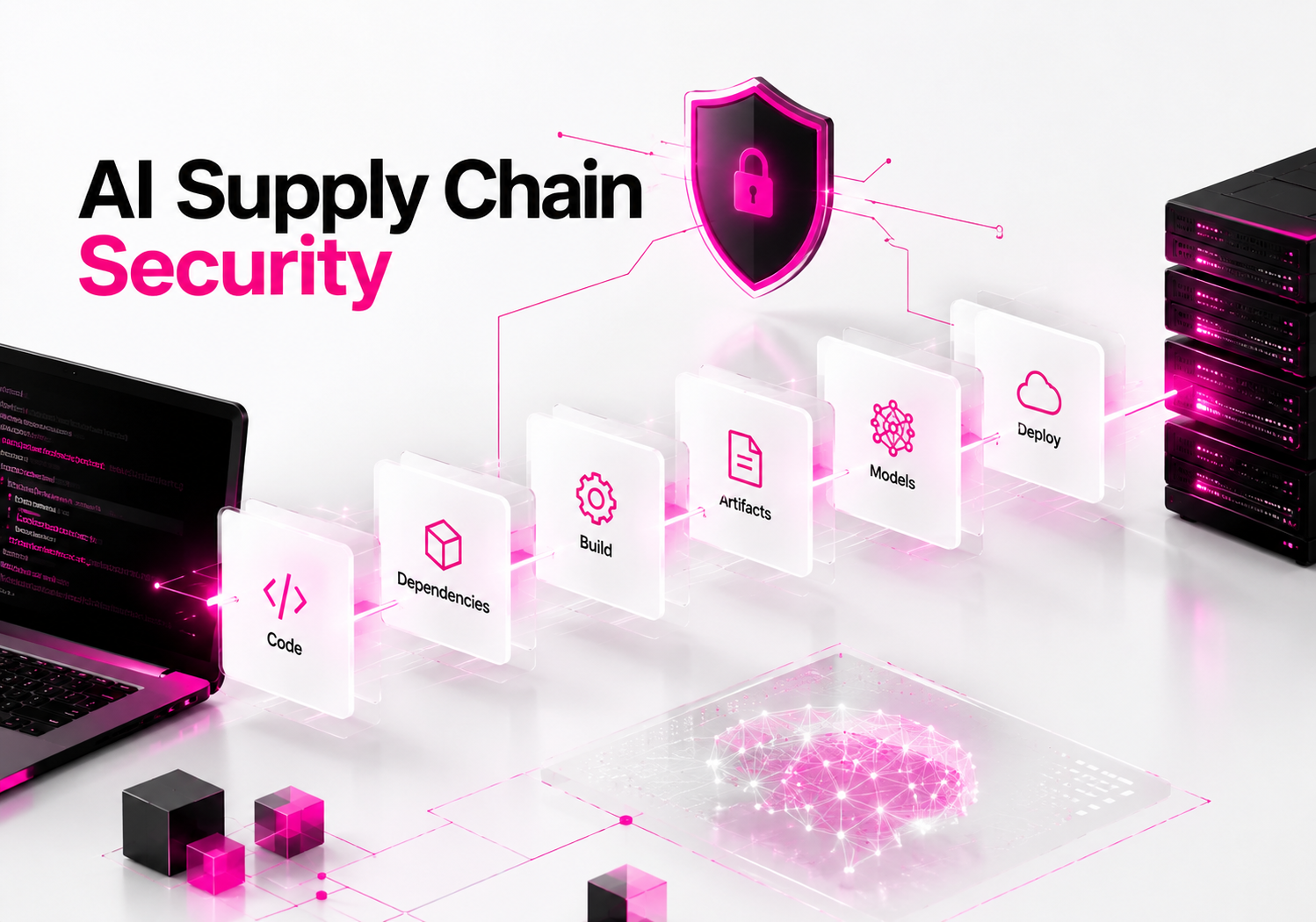
AI software supply chains combine traditional application dependencies with machine-learning frameworks, pretrained models, datasets, containers, plugins, model artifacts, CI/CD pipelines, and increasingly AI-generated code. The strongest security approach is layered: use SBOM and dependency tools for visibility, Sigstore and SLSA for provenance and integrity, OpenSSF Scorecard for project risk, and GUAC to correlate the evidence across the supply chain.
That matters because an AI application can inherit risk long before it reaches production. A vulnerable Python package, compromised build runner, untrusted model artifact, poisoned dataset, or unsigned release can become part of the final system. NIST specifically recommends SBOMs, open-source software controls, vulnerability management, vendor risk assessment, and stronger software verification as supply-chain security capabilities.
For most teams, I would start with Syft + Grype or Dependency-Track for inventory and vulnerability visibility, Sigstore for signing, SLSA for build provenance, OpenSSF Scorecard for dependency and repository hygiene, and GUAC when the environment becomes large enough to need centralized supply-chain intelligence.
What makes AI software supply chains different?
AI supply chains contain more than conventional source-code dependencies. They can include models, datasets, Python packages, container images, notebooks, model-serving frameworks, GPU libraries, build pipelines, and third-party AI services.
The security boundary also extends into artifacts that may not look like ordinary software. OpenSSF’s MLSecOps guidance maps tools such as Scorecard, SLSA, Sigstore, GUAC, CycloneDX, Syft, ModelScan, Grype, and Dependency-Track across different stages of the ML lifecycle.
| Supply-chain layer | Example risk | Useful controls |
|---|---|---|
| Dependencies | Vulnerable or malicious package | SBOM, SCA, vulnerability scanning |
| Models/artifacts | Tampered or untrusted model | Signing, hashes, provenance |
| Build pipeline | Compromised CI/CD process | SLSA, attestations, CI hardening |
| Repositories | Weak project security practices | OpenSSF Scorecard |
| Data | Poisoned or unauthorized data | Validation, lineage, access controls |
This is why installing a single “AI security scanner” is rarely enough.
What are the top tools for securing an AI software supply chain?
The most useful tools fall into different security layers rather than competing directly with each other. The following stack covers inventory, vulnerabilities, provenance, repository security, artifact relationships, and model-specific risks.
1. Syft — generate SBOMs for AI applications
Syft is one of the most useful starting points because you cannot secure dependencies you cannot see. It generates Software Bill of Materials (SBOMs) for container images and filesystems and supports common SBOM formats such as SPDX and CycloneDX.
For an AI application, an SBOM can expose packages hidden several levels below your application code. That is particularly useful for Python-heavy environments where frameworks such as PyTorch, TensorFlow, Transformers, FastAPI, NumPy, and their transitive dependencies can create a large dependency tree.
NIST recommends machine-readable SBOMs and identifies SPDX and CycloneDX among acceptable standardized formats.
Best use: dependency inventory and software composition visibility.
2. Grype — scan AI dependencies for vulnerabilities
Grype complements Syft by scanning software artifacts and SBOMs for known vulnerabilities. It can be incorporated into CI/CD so that a vulnerable dependency is detected before an AI application reaches production.
A practical workflow is:
Source code
   ↓
Syft → SBOM
   ↓
Grype → vulnerability scan
   ↓
CI policy
   ↓
Build / release
This is much more useful than manually checking package advisories after deployment.
Grype should not be treated as proof that an AI system is secure. Known-vulnerability scanning cannot reliably detect malicious-but-undocumented packages, poisoned datasets, unsafe model behavior, or every supply-chain compromise.
3. Sigstore — sign and verify software artifacts
Sigstore provides a strong way to establish that an artifact being deployed is the artifact that was actually signed. It is particularly useful when AI systems produce or consume model files, container images, packages, and other release artifacts.
OpenSSF describes Sigstore as tooling for signing, verifying, and protecting software. Its supply-chain work also places Sigstore alongside SLSA and GUAC as core technologies for improving software supply-chain integrity.
The practical advantage is straightforward: instead of trusting a filename or download location, your deployment process can verify cryptographic signing information before accepting an artifact.
Best use: artifact integrity and release verification.
4. SLSA — establish build provenance
SLSA addresses a different problem from vulnerability scanning: where did an artifact come from, and how was it built?
A clean vulnerability scan does not prove that your build pipeline was trustworthy. SLSA provides a framework for increasing confidence in artifact provenance and build integrity.
For AI software, this can cover the chain from source repository through CI/CD to the container, package, or model-related artifact eventually deployed.
OpenSSF identifies SLSA as a project focused on safeguarding artifact integrity across software supply chains.
Best use: build provenance, reproducibility, and release integrity.
5. OpenSSF Scorecard — assess open-source project risk
OpenSSF Scorecard helps determine whether the open-source projects you depend on follow security best practices. It evaluates areas including source code, builds, dependencies, testing, and project maintenance.
The project produces individual checks and an aggregate score, giving security teams a practical signal when evaluating dependencies.
This is valuable for AI projects because a dependency may have no currently known CVE while still exhibiting weak security practices.
For example, before adopting an obscure package used by an internal AI service, you can examine whether the project uses branch protection, dependency management, signed releases, code review, and other security practices.
Best use: upstream open-source project assessment.
6. GUAC — connect the supply-chain evidence
GUAC becomes valuable when your organization has too much supply-chain information for separate SBOM and scanner reports to remain useful.
GUAC, or Graph for Understanding Artifact Composition, ingests software-security metadata such as SBOMs and maps relationships between software components. Its documentation describes capabilities for querying vulnerabilities through transitive dependencies and correlating information from sources including OSV and OpenSSF Scorecard.
This matters because an AI platform might contain hundreds of packages across multiple services, containers, model-serving systems, and build pipelines.
Instead of asking only:
“Does this package have a vulnerability?”
you can ask questions closer to:
“Which deployed AI services depend on this vulnerable component?”
That relationship-level visibility is where GUAC can become much more useful than another standalone scanner.
7. CycloneDX — standardize AI and software inventory
CycloneDX is useful when you need a standardized way to describe components and relationships in your software supply chain.
It is an SBOM standard rather than a vulnerability scanner itself. NIST lists CycloneDX alongside SPDX and SWID as standardized formats relevant to SBOM exchange.
CycloneDX also appears in OpenSSF’s MLSecOps guidance, including stages such as data engineering, CI, CD, and continuous training.
For organizations using several security tools, standardized SBOM output is critical. It prevents every scanner from maintaining a completely different inventory format.
8. Dependency-Track — continuously monitor SBOMs
Dependency-Track is useful when SBOM generation needs to become an ongoing security-management process rather than a one-time CI job.
It can ingest SBOM information and help organizations monitor component risk across applications. OpenSSF’s MLSecOps guidance includes Dependency-Track among tools applicable to CI and continuous-training stages.
This is particularly useful for organizations with many AI applications where the same library can appear in dozens of services.
The key distinction is that Syft can create the inventory, while a platform such as Dependency-Track can help organizations manage and monitor that inventory over time.
9. ModelScan — inspect AI model files
ModelScan addresses a risk that traditional software dependency scanners can miss: potentially unsafe model serialization formats and model artifacts.
AI applications frequently consume pretrained or internally generated models. Treating every model file as harmless data is a mistake because some serialization mechanisms can contain executable or otherwise dangerous behavior.
OpenSSF’s MLSecOps guidance specifically lists ModelScan in the CI stage alongside SBOM and vulnerability-management tools.
Model scanning should therefore sit alongside—not replace—artifact signing, provenance, dependency analysis, and access controls.
10. OSV — vulnerability intelligence for open source
OSV is useful as a vulnerability data source for identifying known vulnerabilities in open-source dependencies.
Its value increases when combined with SBOM and dependency tooling. GUAC, for example, can use OSV data alongside SBOMs, dependency information, and Scorecard results to create a broader picture of supply-chain exposure.
For AI development teams that depend heavily on open-source Python and JavaScript packages, integrating vulnerability intelligence into CI/CD is considerably more effective than waiting for developers to discover advisories manually.
Which AI supply-chain security tools should you use together?
The biggest mistake is choosing tools because they have overlapping feature lists. Build a security chain in which each tool answers a different question.
| Security question | Recommended tool |
|---|---|
| What components are inside the application? | Syft / CycloneDX |
| Which components have known vulnerabilities? | Grype / OSV |
| Is the upstream project following security practices? | OpenSSF Scorecard |
| Was the artifact produced by the expected build process? | SLSA |
| Can I verify the artifact’s identity and signature? | Sigstore |
| Which systems depend on a risky component? | GUAC |
| Is an AI model artifact potentially unsafe? | ModelScan |
This layered approach is consistent with OpenSSF’s MLSecOps guidance, which treats supply-chain security as a lifecycle problem spanning planning, data engineering, experimentation, CI, deployment, and continuous training.
How do you secure an AI software supply chain step by step?
Start with visibility, then add integrity controls.
Step 1: Generate an SBOM
Create an SBOM for every important AI application and container.
For example:
syft <image-or-directory> -o cyclonedx-json > sbom.jsonStore the SBOM alongside the build metadata rather than generating it only during an incident.
NIST recommends maintaining SBOM information and integrating vulnerability detection with SBOM repositories for automated alerting.
Step 2: Scan dependencies
Feed the SBOM into your vulnerability-management process and scan the application directly where appropriate.
grype sbom:sbom.jsonDo not automatically block every vulnerability. Define policies around severity, exploitability, exposure, compensating controls, and whether the affected component is actually reachable.
Step 3: Evaluate upstream dependencies
Use OpenSSF Scorecard when deciding whether an important open-source project deserves trust.
A package with no known CVEs can still represent supply-chain risk if its repository has weak development and release controls.
Step 4: Establish build provenance
Use SLSA-oriented provenance in your CI/CD pipeline.
The goal is to make the build process itself auditable: source, builder, inputs, outputs, and relevant build information should be connected.
Step 5: Sign release artifacts
Use Sigstore to establish verifiable identity and integrity for releases.
Then configure deployment systems to reject artifacts that fail the required verification policy.
Step 6: Scan model artifacts
Treat externally sourced and internally produced models as supply-chain artifacts.
Do not load an unknown model simply because it comes from a popular repository or has many downloads. Verify its source, inspect its format, scan where appropriate, and establish an approved-model process.
Step 7: Correlate everything
Once your environment becomes large, feed SBOMs, provenance, vulnerability information, and repository-security signals into a system such as GUAC.
That changes supply-chain security from isolated scanner results into a connected inventory.
What should a small AI development team deploy first?
For a small team, do not start by deploying every tool on this list. Start with a manageable baseline:
- Syft for SBOM generation.
- Grype for vulnerability scanning.
- OpenSSF Scorecard for important open-source dependencies.
- Sigstore for release signing and verification.
- SLSA practices for build provenance.
Add ModelScan when your application handles untrusted model artifacts, and add GUAC when the number of applications and supply-chain relationships makes manual correlation difficult.
This gives a small team meaningful coverage without creating a security platform that nobody maintains.
What should enterprises add to the AI supply-chain security stack?
Large organizations need centralized visibility and policy enforcement in addition to developer-focused scanners.
A practical enterprise architecture is:
Source repositories
       ↓
OpenSSF Scorecard
       ↓
CI/CD ──→ SLSA provenance
  ↓
Syft → SBOM → Dependency-Track
  ↓              ↓
Grype / OSV   Vulnerability data
       ↓
   GUAC graph
       ↓
Security policy
       ↓
Signed deployment
       ↓
Production AI systems
The exact implementation will vary, but the architecture has one important property: inventory, vulnerability intelligence, provenance, signing, and relationships are connected rather than treated as separate security projects.
OpenSSF’s published MLSecOps guidance similarly maps Scorecard, SLSA, Sigstore, GUAC, CycloneDX, Syft, ModelScan, Grype, and Dependency-Track across the AI/ML lifecycle.
What are the limitations of AI software supply-chain tools?
No supply-chain tool can prove that an AI system is completely secure.
SBOMs can tell you what components are present, but they do not automatically tell you whether a component is malicious. Vulnerability scanners primarily identify known issues. Signing establishes artifact integrity and identity, but a legitimately signed artifact can still contain a vulnerability.
AI introduces additional problems around dataset provenance, model behavior, prompt injection, insecure plugins, secrets, access control, and deployment configuration. Supply-chain security should therefore be one layer of a broader AI security program.
NIST’s supply-chain guidance explicitly treats SBOMs, open-source controls, vulnerability management, software verification, and vendor risk assessment as complementary capabilities rather than a single security mechanism.
What is the best starting stack for AI software supply-chain security?
For most organizations, I would build around Syft, Grype, Sigstore, SLSA, and OpenSSF Scorecard, then introduce GUAC as supply-chain complexity increases. Add ModelScan when model artifacts are a meaningful part of the attack surface.
The key is not collecting the largest number of security products. It is creating a verifiable chain from source → dependencies → build → artifact → deployment, with enough metadata to investigate what changed and where a risky component is being used.
For authoritative guidance, see NIST Software Security in Supply Chains, OpenSSF Software Supply Chain initiatives, and OpenSSF MLSecOps guidance.
Frequently Asked Questions
What is AI software supply-chain security?
AI software supply-chain security protects the code, dependencies, models, datasets, containers, build systems, and other third-party components used to create and operate AI applications. Effective controls include SBOMs, vulnerability scanning, provenance, artifact signing, dependency assessment, model scanning, and continuous monitoring.
Why is an SBOM important for AI applications?
An SBOM provides a machine-readable inventory of software components and their relationships. For AI applications, this can expose vulnerable or outdated packages buried within frameworks and transitive dependencies. NIST recommends SBOMs as a core software supply-chain capability and supports standardized formats such as SPDX and CycloneDX.
Is OpenSSF Scorecard useful for AI software?
Yes. Scorecard evaluates security practices in open-source projects, including areas related to source code, dependencies, builds, testing, and maintenance. It does not prove that a project is safe, but it provides useful evidence when deciding which open-source dependencies deserve additional review.
What is the difference between SLSA and Sigstore?
SLSA focuses primarily on improving software supply-chain provenance and build integrity, while Sigstore provides mechanisms for signing and verifying software artifacts. They solve related but different problems and can be used together: SLSA helps establish how an artifact was produced, while Sigstore helps verify its cryptographic identity and integrity.
Can SBOMs prevent AI supply-chain attacks?
No. SBOMs improve visibility but do not prevent attacks by themselves. They can help identify affected components quickly when vulnerabilities are discovered. Security teams still need provenance, artifact verification, dependency controls, secure CI/CD, access controls, and monitoring to address broader supply-chain threats.
Should AI models be treated as software supply-chain artifacts?
Yes. Models should be treated as controlled artifacts with known provenance, integrity checks, access controls, and appropriate scanning. This is especially important when models are downloaded from external repositories or moved between development, testing, and production environments. OpenSSF’s MLSecOps guidance includes model-signing and model-scanning considerations within the broader AI/ML lifecycle.
Final Takeaway
Secure the AI supply chain as a chain, not as a collection of scanners. Start by knowing what is inside your applications, identify vulnerable components, establish trustworthy build provenance, sign artifacts, evaluate upstream projects, and verify model artifacts before deployment.
The practical next step is simple: generate an SBOM for one production AI application and connect it to automated vulnerability scanning. Once that inventory works reliably, add provenance and artifact signing rather than trying to implement the entire stack at once.
