

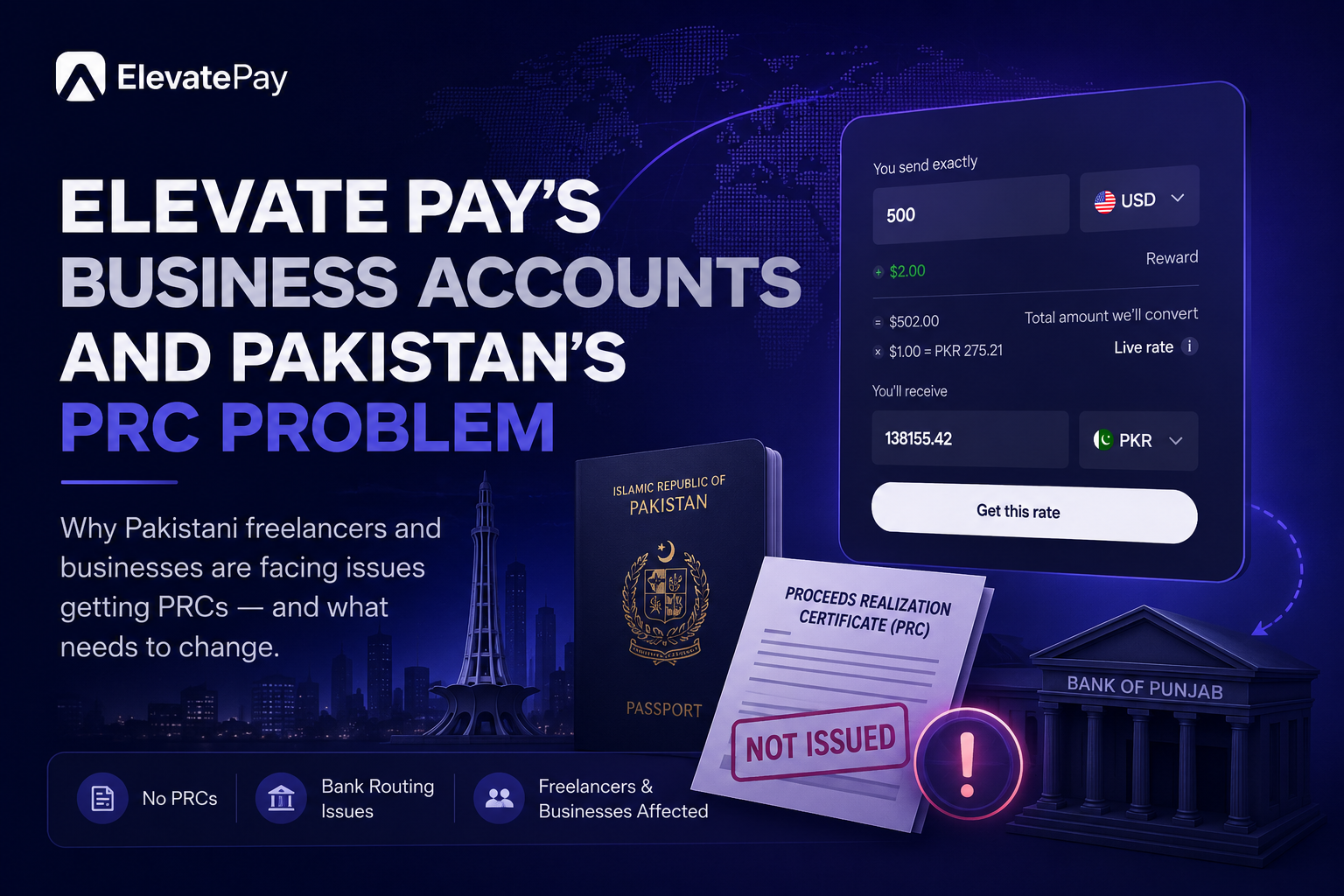
Pakistan’s freelancers, software houses, agencies, and SaaS founders contribute billions of dollars in export revenue every year. One of the most important documents that proves these exports is the Proceeds Realization Certificate (PRC), which is required by many banks, government programs, tax authorities, and organizations such as PSEB.
Over the past year, many Pakistani businesses have started using Elevate Pay because it offers USD accounts designed for freelancers, remote workers, and founders in emerging markets. However, a growing number of users are now reporting difficulties obtaining valid PRCs when using Elevate’s newer business accounts.
This issue is creating uncertainty among exporters and deserves greater attention.
What is Elevate Pay?
Elevate Pay is a US-based fintech company operated by Bloom Financial Technologies Inc. It provides USD accounts for freelancers, remote workers, founders, and businesses outside the United States. The company participated in Y Combinator’s Winter 2022 batch and focuses on helping users in emerging markets receive and manage USD payments through licensed banking partners.
The platform allows users to:
- Receive USD via ACH and wire transfers
- Hold USD balances
- Withdraw funds to local bank accounts
- Open business accounts for agencies and companies
- Manage contractor payments internationally
According to Elevate, its business accounts are designed for agencies, development companies, creative businesses, and founders operating globally.
Why PRCs Matter in Pakistan
For Pakistani exporters, freelancers, and IT companies, a PRC is much more than a payment receipt.
A PRC is commonly required for:
- Export income verification
- PSEB registration and renewals
- Tax documentation
- Bank records
- Government incentive programs
- Foreign exchange reporting
Without a proper PRC, businesses may struggle to prove that their foreign income qualifies as export revenue.
The Problem Emerging with Business Accounts
Since Elevate introduced business accounts, numerous Pakistani users have reported a recurring problem.
Instead of the remittance being processed in a way that generates a usable PRC, many withdrawals appear to be routed through intermediary banking arrangements. Users report that the receiving bank often cannot issue a PRC because the transaction does not arrive as a standard export remittance.
Community discussions also show ongoing confusion around PRC generation and purpose codes, with users reporting inconsistent experiences depending on the receiving bank.
For many businesses, this means:
- Foreign revenue reaches Pakistan.
- Taxes may still be paid.
- The company still cannot obtain the documentation needed to prove exports.
That creates a serious administrative problem.
The Bigger Issue
The concern extends beyond one fintech platform.
Today, thousands of Pakistani freelancers and startup founders rely on international payment providers because local banking options remain limited.
When a payment provider launches a business product that does not consistently support Pakistan’s export documentation requirements, users can face unexpected consequences long after receiving their money.
Many business owners only discover the issue months later when they need PRCs for:
- PSEB compliance
- Audit requirements
- Tax filings
- Bank verification
- Government programs
By then, recovering the required documentation may be difficult or impossible.
Lack of Regulatory Guidance
Perhaps the most frustrating aspect is the absence of clear guidance.
Users are often passed between:
- the payment provider,
- the receiving bank,
- intermediary banks, and
- regulatory institutions.
Each party may explain only its own portion of the payment flow, leaving customers without a practical resolution.
As a result, freelancers and software exporters are left searching through community forums and social media for answers instead of relying on an official process.
Why This Matters
Pakistan’s IT exports continue to grow, and the government actively encourages freelancers and technology companies to bring foreign earnings into the country.
Financial infrastructure should support—not complicate—that process.
International fintech companies serving Pakistan should clearly communicate:
- whether their payment routes generate valid PRCs,
- which receiving banks support them,
- any limitations before customers open business accounts, and
- what alternatives exist if PRCs cannot be issued.
This transparency would allow businesses to make informed decisions before routing significant export revenue through a platform.
A Call for Better Coordination
This issue is not simply about Elevate Pay. It highlights a broader gap between global fintech platforms and Pakistan’s export documentation requirements.
Banks, fintech companies, regulators, and industry bodies should work together to establish clear standards for export remittances and PRC issuance.
Pakistani freelancers and software exporters have earned a reputation worldwide for delivering high-quality services. They deserve a payment ecosystem that recognizes those earnings properly and provides the documentation required to support the country’s growing digital economy.
