

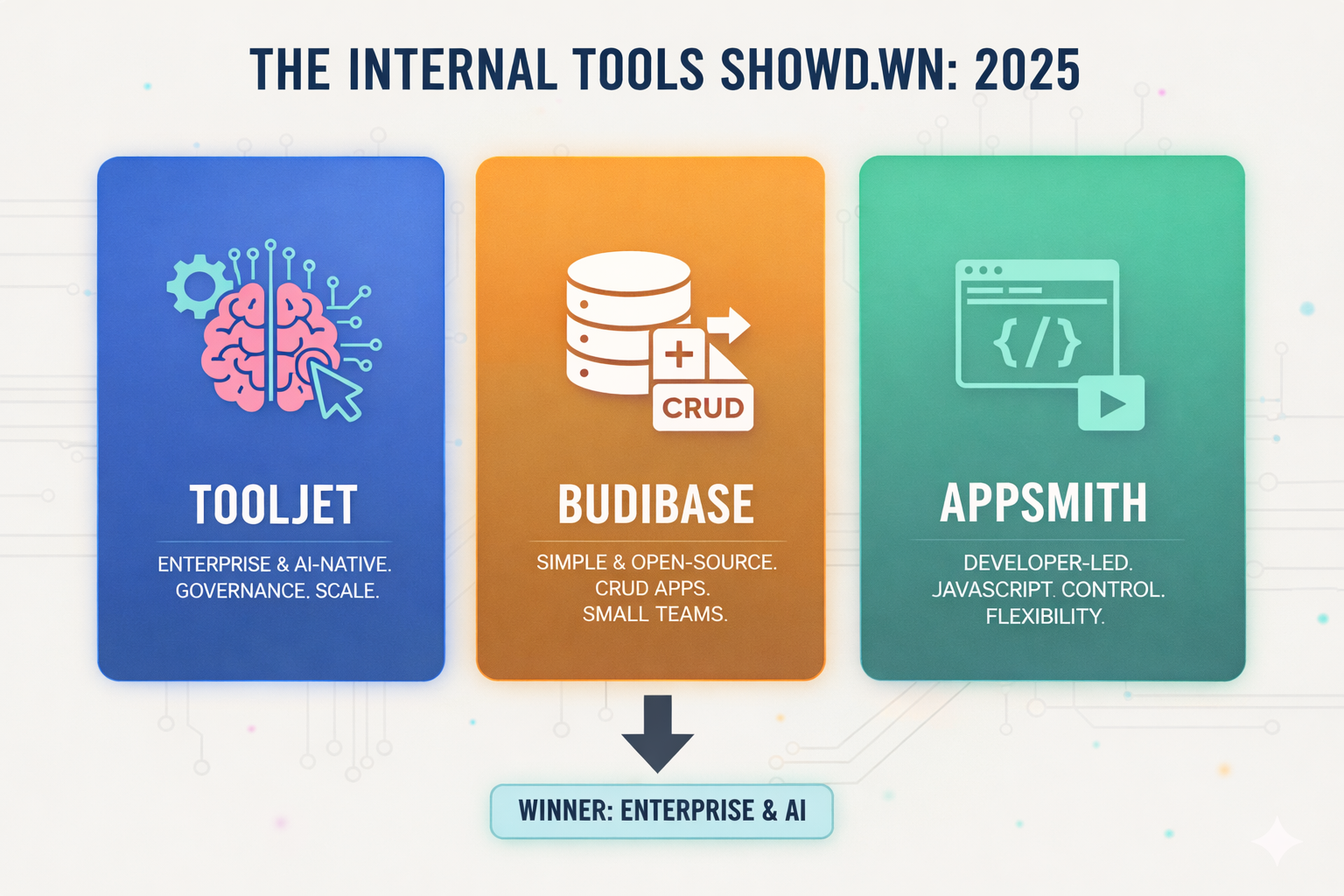
ToolJet is the best choice for enterprises needing scalability, AI-assisted development, and strong governance. Budibase is ideal for small teams that want a simple, open-source CRUD builder. Appsmith sits in the middle, offering flexibility for developers but lacking enterprise depth. If you want speed without sacrificing control, ToolJet currently wins.
Comparison Table: ToolJet vs Budibase vs Appsmith
| Feature | ToolJet | Budibase | Appsmith |
|---|---|---|---|
| Deployment | Cloud, self-hosted, on-prem, air-gapped | Cloud, self-hosted | Cloud, self-hosted |
| Open Source | Yes | Yes | Yes |
| AI-Assisted Building | Native AI builder & agents | Limited | None |
| Enterprise Governance | Advanced RBAC, audit logs, SSO | Basic RBAC | Partial enterprise controls |
| Best For | Enterprises & scale | SMBs & simple CRUD | Developer-led startups |
Interpretation:
ToolJet leads on enterprise readiness and AI. Budibase is best for simplicity and ownership. Appsmith fits teams that want code-first control but don’t need enterprise governance.
Introduction
Internal tools are the backbone of modern operations — from dashboards and admin panels to workflow automation and data interfaces. According to McKinsey (2024), engineers spend nearly 40% of their time building and maintaining internal tools, making efficiency critical.
Low-code and internal tool builders promise faster development without sacrificing flexibility. Among the most popular platforms are ToolJet, Budibase, and Appsmith — all open-source, all developer-friendly, but built for very different needs.
This guide compares them across features, scalability, security, AI capabilities, and cost to help you choose the right one.
What Is an Internal Tool Builder?
An internal tool builder lets teams create custom internal applications using visual components, APIs, and optional code instead of building everything from scratch.
Typical use cases include:
-
Admin dashboards
-
Customer support portals
-
Financial reporting tools
-
Workflow automation systems
-
Data validation and review apps
These tools reduce development cycles from weeks to hours.
ToolJet Overview
ToolJet is an AI-native, open-source low-code platform designed for building enterprise-grade internal tools.
Key Strengths
-
AI-powered app generation (prompt → UI → code)
-
Enterprise-grade security: RBAC, audit logs, SSO, IP allowlisting
-
Self-hosted and air-gapped deployment
-
JavaScript and Python extensibility
-
80+ integrations with databases, APIs, and SaaS tools
Best For
-
Enterprises
-
Security-sensitive industries (finance, healthcare, gov)
-
Engineering-led organizations
Source: ToolJet Docs, 2025
Budibase Overview
Budibase is an open-source, no-code platform optimized for CRUD apps and simple dashboards.
Key Strengths
-
Built-in database
-
Very easy for non-developers
-
Strong self-hosting support
-
Simple automation workflows
Limitations
-
Weak scalability for large datasets
-
Limited customization for complex workflows
-
Fewer enterprise security features
Best For
-
Small to mid-sized teams
-
Operations and HR teams
-
Lightweight internal tools
Source: Budibase Docs, 2025
Appsmith Overview
Appsmith is a developer-focused low-code builder offering visual UI with JavaScript extensibility.
Key Strengths
-
Strong JavaScript support
-
Git-based version control
-
Good for startups and technical teams
-
Open-source and self-hostable
Limitations
-
No AI-assisted building
-
Enterprise governance is limited
-
Performance issues at scale
Best For
-
Developer teams
-
Startups
-
Custom internal tooling with code control
Source: Appsmith Documentation, 2025
Security & Compliance Comparison
| Platform | Security Strength |
|---|---|
| ToolJet | SOC 2 Type II, RBAC, SSO, audit logs, encryption |
| Budibase | Basic RBAC, TLS, optional audit logs |
| Appsmith | Basic encryption, limited governance |
Source: Vendor documentation, 2025
Enterprises handling regulated data need governance — this is where ToolJet leads.
Pricing Comparison (Approximate)
| Platform | Pricing Model |
|---|---|
| ToolJet | Free tier; paid per builder |
| Budibase | Starts ~$50 per creator/month |
| Appsmith | Free tier; business ~$15/user/month |
Source: Vendor pricing pages, 2025
Developer Experience
-
ToolJet offers AI + visual + code, making it fast for both business and technical teams.
-
Budibase is easiest for beginners.
-
Appsmith is best for developers who want full JavaScript control.
Scalability
Gartner (2024) reports that 65% of internal tools fail to scale past departmental use. ToolJet is designed for multi-environment deployments and large teams, while Budibase and Appsmith require more manual infrastructure management as scale increases.
Which Tool Should You Choose?
Choose ToolJet if:
-
You need enterprise security and governance
-
You want AI-assisted development
-
You operate in regulated industries
Choose Budibase if:
-
You want simplicity
-
You’re building CRUD tools
-
You’re a small team with limited technical resources
Choose Appsmith if:
-
You want deep JavaScript control
-
You’re a startup or dev-first company
-
You don’t need enterprise governance
Final Verdict
ToolJet wins overall for most modern organizations. It balances speed, flexibility, enterprise security, and future-proof architecture better than Budibase or Appsmith.
Budibase is excellent for simplicity. Appsmith is solid for developer control. But ToolJet offers the strongest foundation for scalable, secure internal tooling.
FAQs
1. Is ToolJet open source?
Yes, ToolJet is fully open source and supports self-hosting.
2. Is Budibase good for enterprises?
Not ideal. It lacks enterprise-grade governance and scalability.
3. Can Appsmith handle large datasets?
It can, but performance may degrade without tuning.
4. Which tool avoids vendor lock-in?
All three are open source, but ToolJet offers the best enterprise portability.
5. Which is best for non-technical teams?
Budibase is the easiest for non-developers.
