

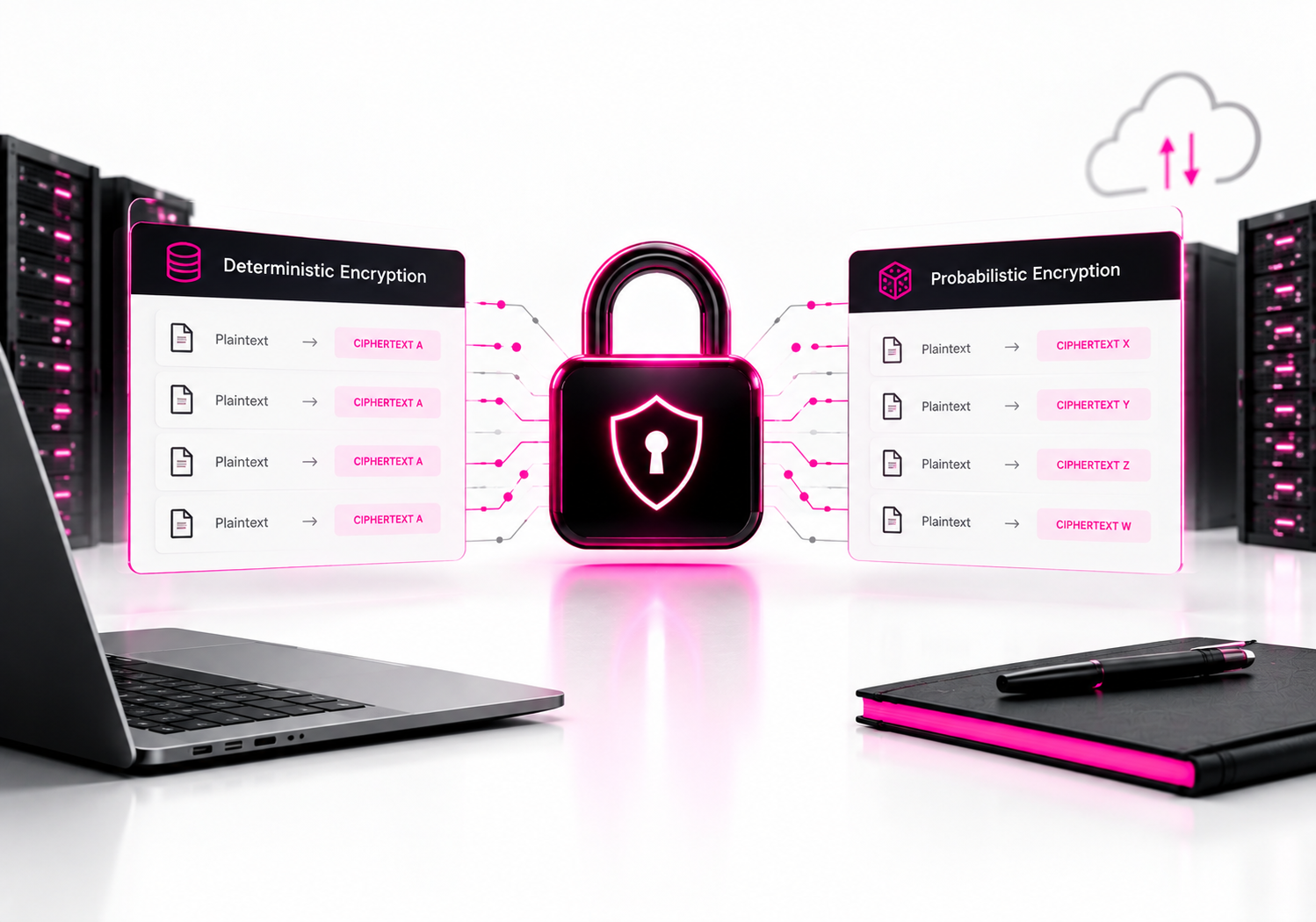
Deterministic encryption produces the same ciphertext every time the same plaintext is encrypted with the same key, while probabilistic encryption uses randomness so repeated encryptions normally produce different ciphertexts. Deterministic encryption can enable equality searches but leaks repetition; probabilistic encryption provides stronger privacy against pattern analysis and is the normal choice for general-purpose data protection.
The distinction matters because encryption does more than hide the plaintext. It also determines what an observer can learn from ciphertext. If ten users have the same encrypted value, deterministic encryption can make those repeated values visibly identical. Probabilistic encryption deliberately breaks that relationship.
That makes neither approach universally better. Deterministic encryption has legitimate uses, including some searchable-data designs and cryptographic key wrapping. NIST, for example, specifies deterministic authenticated-encryption modes for AES key wrapping, while Google Tink documents deterministic AEAD for specialized use cases such as searchable encrypted data.
For ordinary application data, however, randomized authenticated encryption should generally be the default.
What is the difference between deterministic and probabilistic encryption?
Deterministic encryption always maps the same plaintext and key to the same ciphertext. Probabilistic encryption introduces cryptographic randomness, so encrypting the same plaintext multiple times normally produces different ciphertexts.
A simplified deterministic example looks like this:
Plaintext:  "[email protected]"
Key:        K

Encryption #1 → CIPHERTEXT-A
Encryption #2 → CIPHERTEXT-A
Encryption #3 → CIPHERTEXT-A
With probabilistic encryption:
Plaintext:  "[email protected]"
Key:        K

Encryption #1 → CIPHERTEXT-X
Encryption #2 → CIPHERTEXT-Y
Encryption #3 → CIPHERTEXT-Z
All three probabilistic ciphertexts still decrypt to the same plaintext.
The difference comes from randomness or a nonce/IV incorporated into the encryption process. OWASP recommends that cryptographic IVs and nonces be generated and used according to the requirements of the selected encryption mode, and emphasizes that authenticated encryption should be preferred.
| Property | Deterministic | Probabilistic |
|---|---|---|
| Same plaintext → same ciphertext | Yes | Normally no |
| Reveals repeated values | Yes | Strongly reduces this leakage |
| Equality searching | Easier | Requires specialized design |
| General-purpose data protection | Limited use | Usually preferred |
Why does deterministic encryption reveal information?
Deterministic encryption leaks equality information because identical plaintexts produce identical ciphertexts. An attacker may not know the plaintext, but can still determine that two encrypted values are the same.
Imagine a database containing encrypted medical-plan identifiers:
Record 1 → X7F91...
Record 2 → K2A44...
Record 3 → X7F91...
Record 4 → X7F91...
The attacker cannot immediately read the value represented by X7F91....
But the attacker can see that records 1, 3, and 4 contain the same plaintext.
That seemingly small piece of information can become valuable when plaintexts have predictable distributions.
Google’s documentation for Deterministic AEAD explicitly describes this limitation: an attacker who learns the ciphertext corresponding to a particular message can identify other occurrences of that message. The security guarantee therefore allows leakage of plaintext length and equality of repeated plaintexts.
Research on deterministic encryption and encrypted databases has also documented frequency leakage and inference attacks resulting from repeated ciphertext patterns.
Why is probabilistic encryption usually more private?
Probabilistic encryption hides repeated ciphertext patterns by incorporating fresh cryptographic randomness into encryption, making it much harder for an observer to determine whether two ciphertexts represent the same plaintext.
Suppose the plaintext is:
"Pakistan"A probabilistic encryption scheme could produce:
C1 = 9F4A...
C2 = 71B2...
C3 = D84E...
An observer sees three different ciphertexts instead of one repeated value.
This removes a major source of information leakage.
That is one reason secure encryption APIs normally manage IVs or nonces automatically rather than asking developers to invent fixed values. OWASP specifically warns against predictable or reused IVs and recommends secure cryptographic randomness where the selected mode requires it.
Is deterministic encryption less secure?
Deterministic encryption is not automatically broken or useless, but it provides a different security property and deliberately leaks equality. It should therefore be used only when that leakage is acceptable and the cryptographic construction is designed for deterministic use.
This distinction matters.
A common mistake is to say:
Deterministic encryption = insecure.
That is too broad.
NIST SP 800-38F specifies AES Key Wrap (KW) and AES Key Wrap with Padding (KWP) as deterministic authenticated-encryption modes for protecting cryptographic keys. NIST explicitly recognizes deterministic authenticated encryption as an appropriate construction for key wrapping.
The RFC 5297 SIV construction also describes deterministic authenticated encryption and explains its use for key wrapping and related specialized scenarios.
The correct question is therefore:
What information can an attacker learn from the deterministic property, and is that acceptable for this application?
When is deterministic encryption useful?
Deterministic encryption is useful when an application genuinely needs equality matching or deterministic output, provided the resulting information leakage is understood and accepted.
Common examples include:
Encrypted equality searches
A system may need to find records matching an exact encrypted value.
For example:
Find customers where encrypted_customer_id = XWith ordinary randomized encryption, encrypting the search value again would normally produce a different ciphertext, so simple ciphertext equality would not work.
Specialized deterministic encryption can make this possible.
Key wrapping
Cryptographic keys are a classic specialized use case.
NIST’s SP 800-38F specifies deterministic AES Key Wrap and Key Wrap with Padding for protecting cryptographic keys.
Specialized database encryption
Some encrypted database systems need equality operations while data remains encrypted.
But this is not free.
You trade some confidentiality against functionality.
Google Tink makes the same point: deterministic AEAD can support searchable data, but repeated plaintext equality becomes observable.
When should you use probabilistic encryption?
Use probabilistic encryption as the default for ordinary sensitive application data when there is no explicit requirement for deterministic ciphertext.
Good candidates include:
- Personal information
- Confidential documents
- Customer records
- Private messages
- API payloads
- Sensitive application fields
- Stored secrets that require encryption rather than hashing
- Files and backups
For modern application encryption, don’t implement a deterministic construction simply because it is easier to compare ciphertexts.
Use a standard authenticated-encryption API and let the cryptographic library manage its required nonce or IV behavior.
OWASP recommends authenticated encryption and specifically identifies GCM and CCM as preferred authenticated modes when appropriate. It also warns that IV and nonce handling must follow the requirements of the selected mode.
Does probabilistic encryption make database searches impossible?
No. It makes naive ciphertext equality searches unsuitable, but specialized searchable-encryption architectures can provide controlled query functionality while managing the resulting leakage.
This is an important distinction.
Suppose a database stores:
Encrypted email
Encrypted phone
Encrypted address
With randomized encryption, you cannot simply encrypt "[email protected]" again and expect to receive the same ciphertext stored in the database.
Instead, applications may use separate mechanisms such as:
- Search tokens
- Blind indexes
- Deterministic encryption for carefully selected fields
- Searchable encryption schemes
- Specialized database encryption features
Each approach has different leakage and security properties.
Research into searchable encryption has shown that encrypted search can expose information such as search patterns, access patterns, frequency, and result relationships depending on the construction.
So “searchable” does not mean “leakage-free.”
What is the security trade-off between the two?
Deterministic encryption trades some privacy against predictable equality operations, while probabilistic encryption prioritizes confidentiality against pattern analysis at the cost of making straightforward equality searches harder.
Think of it as a design decision:
| Requirement | Better fit |
|---|---|
| Hide repeated values | Probabilistic |
| Simple exact equality matching | Deterministic |
| General sensitive data | Probabilistic |
| Specialized key wrapping | Deterministic |
| Searchable encrypted fields | Specialized deterministic/search design |
The more predictable your plaintext values are, the more carefully you should evaluate deterministic encryption.
A field containing random 256-bit identifiers has a different leakage profile from a field containing one of 20 common country names.
That is why security reviews should examine the data distribution, not just the encryption algorithm.
Is deterministic encryption the same as AES-ECB?
No, but AES-ECB is a classic example of deterministic encryption behavior and should not be used for ordinary application data.
ECB encrypts identical plaintext blocks into identical ciphertext blocks under the same key.
That allows patterns in structured plaintext to remain visible.
OWASP explicitly recommends avoiding ECB outside very specific circumstances. It also recommends authenticated encryption for modern applications.
There is an important distinction here:
A purpose-built deterministic authenticated-encryption scheme is not the same thing as taking AES and using ECB or a fixed IV.
For example, AES-SIV is specifically designed for authenticated encryption and can provide deterministic authenticated encryption in appropriate configurations. RFC 5297 describes SIV as a construction capable of deterministic authenticated encryption and nonce-based misuse-resistant authenticated encryption.
Never create deterministic encryption by simply hard-coding an IV into a normal randomized encryption mode.
How should developers implement encryption safely?
Start by choosing the security property you actually need, then use a vetted library or construction rather than designing your own encryption scheme.
A practical checklist:
1. Decide whether equality leakage is acceptable
Ask:
If an attacker sees two identical ciphertexts, is learning that the underlying values are equal acceptable?
If not, deterministic encryption is probably the wrong choice.
2. Determine whether searching is really required
Don’t choose deterministic encryption just because someone says, “We need to search the encrypted database.”
Define the exact query:
- Exact equality?
- Prefix search?
- Range query?
- Full-text search?
- Sorting?
Different requirements produce different leakage and cryptographic designs.
3. Use authenticated encryption
Encryption should normally provide confidentiality and integrity.
OWASP’s current cryptographic guidance recommends authenticated encryption rather than encryption alone.
4. Never reuse nonces incorrectly
Nonce and IV requirements depend on the cryptographic construction.
OWASP’s guidance states that an IV should never be reused with a fixed key when the mode requires uniqueness.
Don’t invent your own nonce-generation scheme.
5. Protect the encryption keys
Strong encryption cannot compensate for an exposed key.
OWASP recommends dedicated cryptographic key storage such as HSMs or isolated key-management services where appropriate and says keys should not be stored in plaintext.
6. Document leakage
For deterministic encryption, document explicitly that repeated plaintext values produce repeated ciphertext values.
That should be part of the threat model, not an accidental discovery during an incident.
What should you choose for a new application?
For a new application, choose standard probabilistic authenticated encryption unless you have a clearly documented requirement for deterministic behavior.
For most application data, the decision should look like this:
Need ordinary confidentiality?
        ↓
Use authenticated randomized encryption
        ↓
Need exact encrypted equality search?
        ↓
Evaluate specialized deterministic/searchable design
        ↓
Can equality leakage be accepted?
        ↓
Use an appropriate deterministic AEAD construction
Don’t solve a database-query problem by weakening encryption across every field.
A better architecture often encrypts sensitive values probabilistically while maintaining a separate, deliberately designed lookup mechanism for the small number of fields that genuinely require equality searches.
That limits the amount of information exposed by deterministic processing.
FAQ: Deterministic vs Probabilistic Encryption
What is the main difference between deterministic and probabilistic encryption?
Deterministic encryption produces the same ciphertext for identical plaintext and key combinations. Probabilistic encryption introduces cryptographic randomness so repeated encryptions normally produce different ciphertexts. The trade-off is that deterministic encryption supports straightforward equality matching but reveals repeated-value relationships.
Is probabilistic encryption more secure than deterministic encryption?
For general-purpose confidentiality, probabilistic encryption normally provides stronger privacy because it hides repeated ciphertext patterns. Deterministic encryption is not inherently broken, but it deliberately reveals equality information. Its security can be appropriate for specialized applications when that leakage is understood and acceptable.
Can deterministic encryption be searched?
Yes. Deterministic encryption can make exact equality searches practical because the same plaintext produces the same ciphertext. However, the resulting ciphertext patterns can reveal which records contain equal values and may expose frequency information. Searchable encryption can offer more sophisticated functionality, but it also has its own leakage considerations.
Is AES deterministic or probabilistic?
AES itself is a block cipher, not a complete encryption scheme that dictates whether repeated plaintext produces repeated ciphertext. The surrounding mode and parameters determine the behavior. AES-ECB is deterministic for identical blocks, while modern authenticated modes such as AES-GCM use a nonce and normally produce different ciphertexts for repeated plaintext.
Should I use deterministic encryption for database fields?
Only when exact equality matching is genuinely required and the associated leakage is acceptable. For ordinary sensitive fields, randomized authenticated encryption is usually the safer default. If a searchable field is necessary, consider a purpose-built design such as deterministic AEAD or a separate protected lookup mechanism rather than using ECB or a fixed IV.
Final Verdict: Deterministic or Probabilistic Encryption?
Probabilistic authenticated encryption should be the default for protecting ordinary sensitive data. Deterministic encryption has a legitimate role when exact equality matching, key wrapping, or another specialized requirement justifies revealing equality patterns.
The key mistake is treating deterministic output as a convenience with no security cost. It is a deliberate information leak.
Your next step: inventory the fields you plan to encrypt and mark which ones actually require equality searches. Keep ordinary sensitive fields probabilistically encrypted, and use deterministic techniques only where the functionality genuinely requires them.
