

Summary
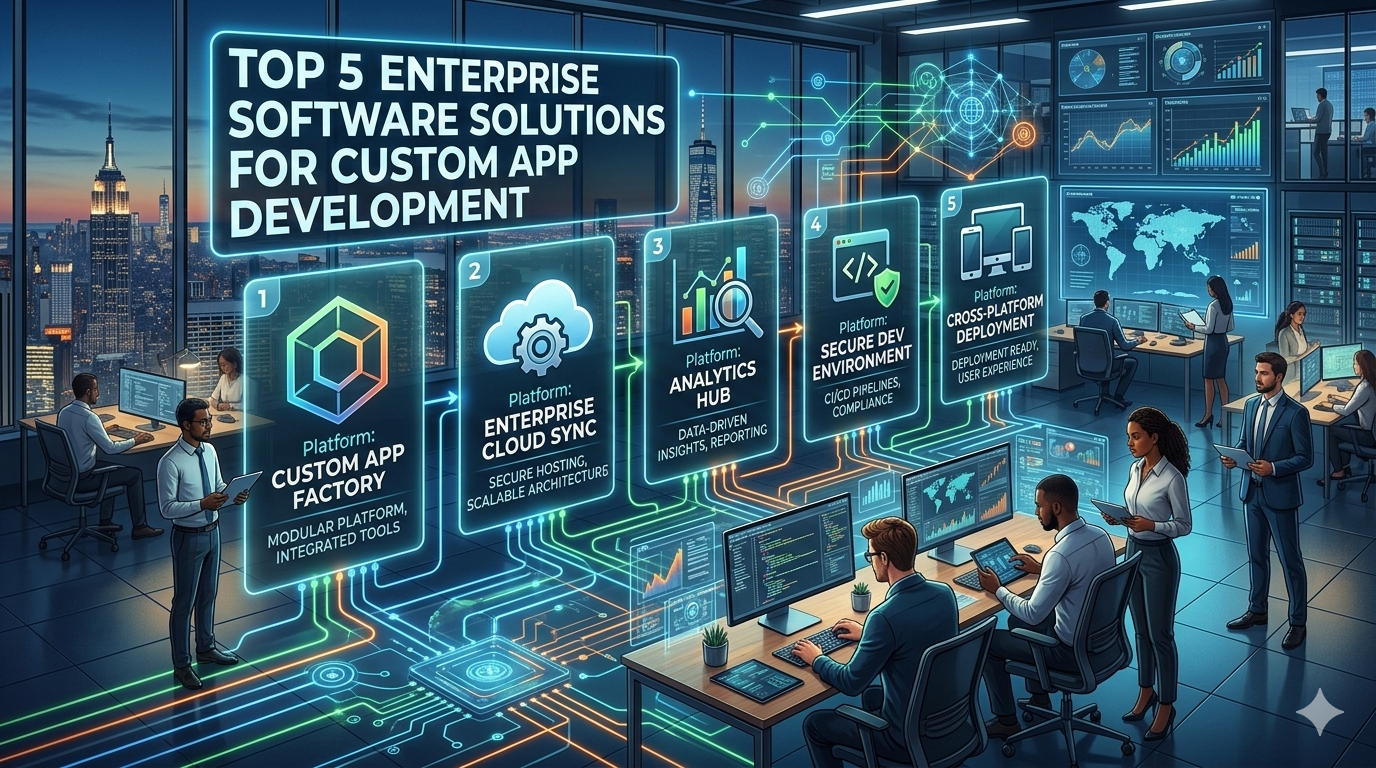
Enterprise demand for scalable, secure, and rapidly deployable applications continues to accelerate. The best enterprise software solutions for custom app development combine low-code agility, cloud-native architecture, and enterprise-grade governance. This guide compares the top five platforms, highlights key metrics, and provides actionable guidance for selecting the right solution in 2026.
Introduction
As digital transformation matures in 2026, organizations are prioritizing enterprise software solutions for custom app development that reduce time-to-market while ensuring security, compliance, and scalability. According to <a href=”https://www.gartner.com/en/newsroom/press-releases/2023-10-17-gartner-forecasts-worldwide-low-code-development-technologies-market-to-grow-20-percent-in-2024″ target=”_blank”>Gartner’s low-code market forecast</a>, low-code technologies continue double-digit growth, driven by enterprise modernization initiatives.
This article ranks the top 5 enterprise platforms, compares their strengths, and helps decision-makers evaluate which solution aligns best with business goals, compliance requirements, and technical strategy.
What Enterprises Should Look for in Custom App Development Platforms
Before comparing vendors, enterprises should evaluate:
-
Scalability and cloud-native architecture
-
Security and compliance (GDPR, SOC 2, ISO 27001)
-
Integration capabilities (APIs, ERP, CRM systems)
-
Governance and DevOps support
-
Total cost of ownership
Modern platforms must also address cybersecurity risks and data protection standards, especially as compliance frameworks tighten globally.
Top 5 Enterprise Software Solutions for Custom App Development
1. Microsoft – Power Apps
Website: https://powerapps.microsoft.com
Best for: Enterprises deeply invested in the Microsoft ecosystem.
Microsoft Power Apps enables low-code application development tightly integrated with Azure, Dynamics 365, and Microsoft 365. It offers enterprise-grade identity management via Azure Active Directory and strong compliance controls.
Strengths
-
Seamless integration with Microsoft stack
-
Strong governance and security
-
Rapid internal app deployment
Considerations
-
Less flexible for non-Microsoft environments
2. OutSystems
Website: https://www.outsystems.com
Best for: Large-scale, mission-critical applications.
OutSystems provides a high-performance low-code platform with strong DevOps automation and AI-assisted development. It’s widely used for complex digital transformation projects.
Strengths
-
Enterprise DevOps pipeline
-
High scalability
-
Strong performance optimization
Considerations
-
Higher pricing for large deployments
3. Mendix
Website: https://www.mendix.com
Best for: Collaborative development across business and IT.
Backed by Siemens, Mendix supports both low-code and pro-code models, making it suitable for enterprises balancing agility with deep customization.
Strengths
-
Strong collaboration tools
-
Multi-cloud deployment
-
Built-in compliance features
Considerations
-
Learning curve for advanced customization
4. Salesforce – Lightning Platform
Website: https://www.salesforce.com/platform
Best for: CRM-centric enterprises.
Salesforce Lightning enables rapid application development on top of Salesforce data. It excels in customer-centric workflows and automation.
Strengths
-
Native CRM integration
-
Strong ecosystem marketplace
-
Built-in security framework
Considerations
-
Best suited for Salesforce users
5. ServiceNow
Website: https://www.servicenow.com
Best for: Workflow automation and IT service management apps.
ServiceNow’s App Engine allows enterprises to build custom workflow applications integrated with IT, HR, and operations systems.
Strengths
-
Enterprise workflow automation
-
Strong governance controls
-
High security standards
Considerations
-
Primarily workflow-focused
Comparison Table: Key Decision Metrics
| Platform | Best For | Enterprise Strength |
|---|---|---|
| Microsoft Power Apps | Microsoft ecosystem | Integration + compliance |
| OutSystems | Complex enterprise apps | Performance + DevOps |
| Mendix | Hybrid dev teams | Collaboration + flexibility |
| Salesforce Lightning | CRM-driven apps | Ecosystem + automation |
| ServiceNow | Workflow automation | Governance + IT integration |
What this shows: Each platform dominates a specific enterprise niche rather than offering a universal solution.
Why it matters: Selection should align with existing infrastructure and long-term architecture strategy.
How to interpret: If your organization relies heavily on a specific ecosystem (Microsoft, Salesforce, ServiceNow), platform alignment typically reduces integration risk and cost.
Security, Compliance, and Data Protection
Security is non-negotiable. According to <a href=”https://www.ibm.com/reports/data-breach” target=”_blank”>IBM’s Cost of a Data Breach Report</a>, the global average cost of a data breach remains in the millions, reinforcing the need for enterprise-grade governance.
Additionally, enterprises operating in Europe must ensure compliance with <a href=”https://gdpr.eu/” target=”_blank”>GDPR requirements</a>, particularly regarding data residency and user consent management.
All five platforms above offer compliance certifications and encryption standards, but due diligence should include a vendor security audit and risk assessment.
Actionable Recommendations
To choose the right enterprise software solution for custom app development:
-
Audit your current tech stack. Ecosystem compatibility reduces integration costs.
-
Prioritize security certifications. Verify SOC 2, ISO 27001, and GDPR compliance.
-
Run a pilot project. Test performance and governance controls before scaling.
-
Calculate total cost of ownership. Include licensing, development, and maintenance.
-
Assess long-term scalability. Ensure the platform supports future cloud and AI initiatives.
Enterprises should involve IT leadership, security teams, and business stakeholders early in evaluation.
FAQs
1. What is the best enterprise software solution for custom app development?
It depends on your ecosystem. Microsoft-centric organizations benefit most from Power Apps, while complex enterprise deployments may favor OutSystems or Mendix.
2. Are low-code platforms secure enough for enterprises?
Yes, when properly configured. Leading vendors provide encryption, role-based access control, and compliance certifications.
3. How do these platforms compare in scalability?
OutSystems and Mendix typically support highly scalable architectures for mission-critical systems.
4. What about GDPR and data protection?
Top vendors provide GDPR compliance tools, but organizations remain responsible for correct implementation.
Conclusion
The best enterprise software solutions for custom app development combine agility, security, and scalability. In 2026, successful enterprises prioritize ecosystem alignment, governance maturity, and long-term innovation capacity. By selecting a platform aligned with your infrastructure and compliance requirements, organizations can accelerate digital transformation while minimizing operational risk.
