

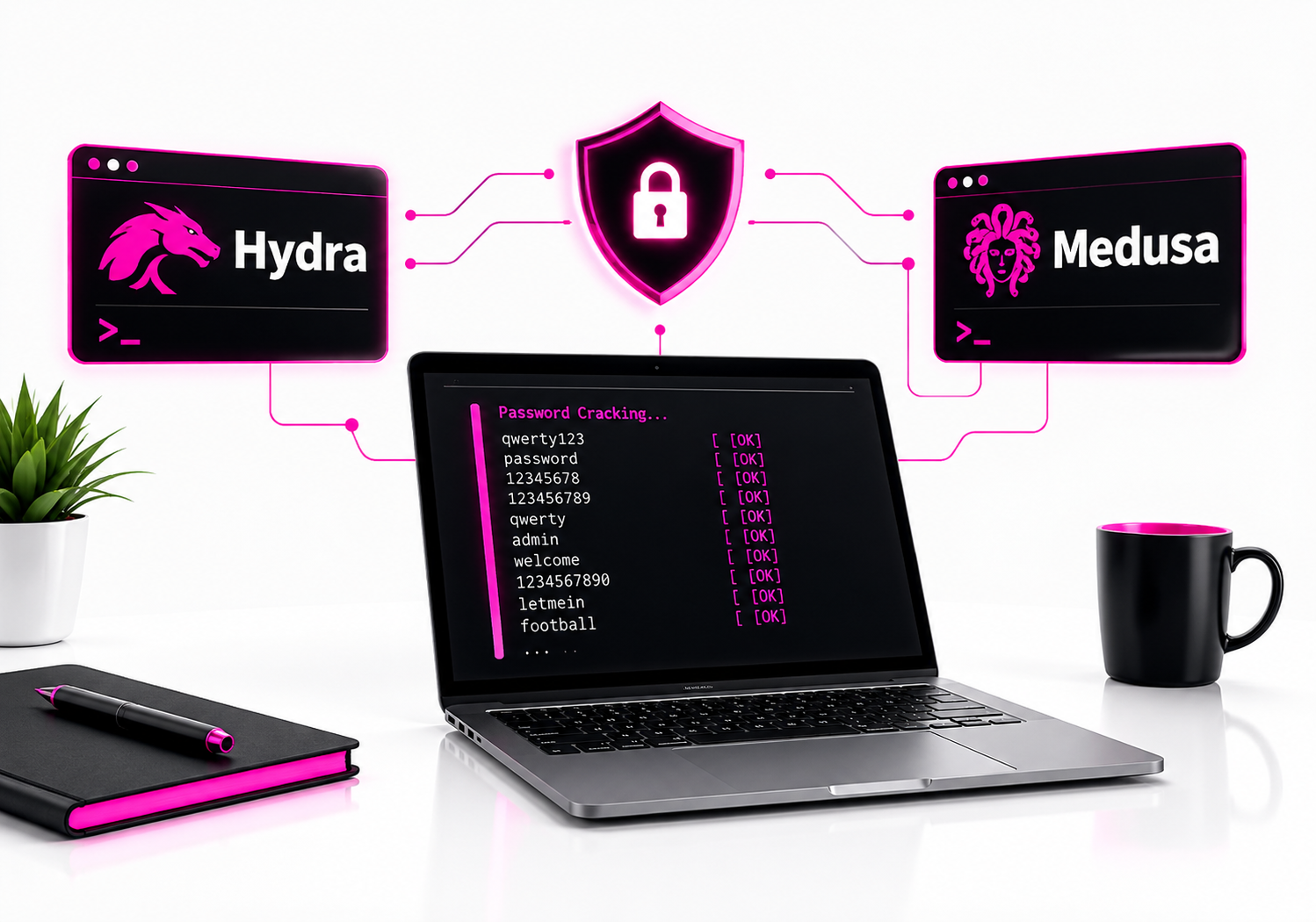
Hydra and Medusa are both network login auditing tools designed to test authentication services with automated credential attempts, but they differ in architecture and workflow. Hydra has broader protocol support and a mature, flexible command-line interface, while Medusa emphasizes thread-based parallel testing and modular service support. For authorized penetration testing, Hydra is usually the more versatile choice.
The two tools are often mentioned together because they solve a similar problem: testing whether network services are vulnerable to weak or guessable credentials. Neither should be confused with offline password crackers such as Hashcat or John the Ripper. Hydra and Medusa primarily target remote authentication services, whereas offline crackers work against captured password hashes or other credential material.
That distinction matters when choosing the right tool for a security assessment. The best option depends less on which tool is “faster” and more on the protocols you need to test, how much control you want over the assessment, and how the target service responds to repeated authentication attempts.
Safety note: Hydra and Medusa should only be used against systems you own or have explicit permission to test. The comparison below focuses on authorized security assessment rather than providing credential-attack commands or operational attack instructions.
What is the difference between Hydra and Medusa?
Hydra and Medusa both automate login-credential testing against supported network services, but Hydra is generally broader and more flexible, while Medusa is built around a modular, thread-based architecture.
Hydra describes itself as a parallelized login cracker supporting numerous protocols. Its documentation exposes configurable tasks, service modules, target lists, credential inputs, and connection behavior.
Medusa describes itself as a “speedy, parallel, and modular” login brute-forcer. Its project documentation specifically highlights thread-based parallel testing against multiple hosts, users, or passwords and independent service modules.
| Area | Hydra | Medusa |
|---|---|---|
| Primary strength | Broad protocol support and flexibility | Modular, parallel authentication testing |
| Architecture | Parallel tasks + service modules | Thread-based + independent modules |
| Best fit | General-purpose network auditing | Structured multi-target authentication testing |
The overlap is significant. The practical difference appears when you start evaluating protocol coverage, module behavior, target handling, and the workflow your security team already uses.
Is Hydra better than Medusa?
For most penetration-testing teams, Hydra is the better general-purpose choice because of its broad protocol coverage, flexible configuration, and mature ecosystem. Medusa remains a strong alternative when its modular architecture and concurrency model fit the assessment better.
Hydra’s official documentation exposes support for many services and allows testers to control parallel tasks, target lists, credential sources, connection timing, and module-specific options.
Medusa takes a similarly modular approach but explicitly focuses on thread-based parallel testing. Its current repository lists support for services including SMB, HTTP, MS-SQL, POP3, RDP, and SSHv2.
The important point is that “faster” is not a universal property.
A tool’s real-world performance depends on:
- The protocol being tested
- Server-side throttling
- Authentication latency
- Network distance
- Concurrent connection limits
- Account lockout policies
- Whether the service supports the authentication method
- How the tool’s module implements that protocol
A raw attempts-per-second comparison without controlling those variables would be misleading.
How does Hydra work?
Hydra performs automated authentication testing against supported network services using configurable login, password, target, and concurrency inputs.
The tool’s architecture allows security testers to select a service module and provide authentication-test inputs. Hydra can also operate against multiple targets and adjust parallel task counts. Its documentation lists a default of 16 parallel tasks for its -t setting, while also providing controls for wait times and connection behavior.
That flexibility makes Hydra useful in authorized assessments where the same authentication weakness needs to be evaluated across different services.
Its supported-service model is one of its biggest strengths. The project documentation includes numerous network services and provides module-specific options through the tool’s help system.
Why does Hydra remain popular?
Three reasons stand out:
- Protocol coverage — it supports many network authentication services.
- Flexible input handling — testers can work with individual credentials or lists.
- Concurrency controls — the tester can tune parallel connections according to the service and lab environment.
The third point deserves caution. More parallel connections do not automatically mean better testing. Some services intentionally throttle authentication attempts, and aggressive concurrency can create unnecessary load or trigger defensive controls.
How does Medusa work?
Medusa uses a modular, thread-based design for parallel authentication testing across supported services.
Its official repository identifies three major characteristics: thread-based parallel testing, flexible target input, and independent service modules. The project says testing can be performed concurrently against multiple hosts, users, or passwords.
The modular architecture is particularly useful for security testers who want service-specific functionality without changing the core application.
Medusa’s repository currently lists modules for services including:
- SMB
- HTTP
- MS-SQL
- POP3
- RDP
- SSHv2
It also supports other authentication services through its module system.
What makes Medusa different?
The biggest architectural distinction is how explicitly the project centers its design around thread-based parallel testing and independent modules.
That makes Medusa attractive when an assessment involves multiple authentication targets and the tester wants a clean modular structure.
It does not automatically make Medusa faster than Hydra. The target service remains the limiting factor in many real assessments.
Hydra vs Medusa: which supports more protocols?
Hydra generally has the advantage when protocol breadth is the primary consideration, although Medusa supports a substantial collection of network services as well.
Hydra’s official manual lists a long range of supported services, including FTP, FTPS, SSH, HTTP-related services, SMB-related services, databases, mail protocols, and others.
Medusa’s project documentation lists many commonly assessed authentication services, including SMB, HTTP, MS-SQL, POP3, RDP, and SSHv2.
For an actual engagement, however, do not select the tool based on a generic protocol-count comparison.
Instead ask:
Does the tool’s current module support the exact authentication method used by my target?
For example, knowing that a tool supports SSH does not mean every SSH authentication configuration will behave identically. The service may disable password authentication entirely or require another authentication mechanism.
Which is faster: Hydra or Medusa?
There is no reliable universal winner between Hydra and Medusa because authentication speed is heavily constrained by the target service, network conditions, and defensive controls.
Both tools are designed for parallel testing. Hydra exposes task and connection controls, while Medusa explicitly uses threads for concurrent testing.
A useful benchmark therefore needs to control:
- Same target
- Same protocol
- Same network path
- Same credential dataset
- Same authentication method
- Same concurrency
- Same server configuration
- Same rate limits
- Same hardware
Without that, a claim such as “Hydra is 2× faster” is not meaningful.
There is another problem: deliberately increasing authentication traffic can trigger lockouts or security controls. A responsible penetration test should reproduce realistic conditions rather than simply maximize requests.
Which tool is easier to use?
Hydra is generally easier to find in penetration-testing workflows because its syntax, documentation, and module model are widely represented in security distributions and training environments.
Medusa is also straightforward once its architecture is understood, particularly if you work with multiple modules and concurrent targets.
The choice often comes down to familiarity.
A tester who already understands Hydra’s service/module model can usually move quickly between supported protocols. Someone who prefers Medusa’s thread-oriented modular structure may find it equally productive.
For a team, consistency matters more than personal preference. Standardizing one tool and documenting safe testing procedures is usually better than having every tester choose a different credential-auditing workflow.
Hydra vs Medusa: which is better for penetration testing?
Hydra is the stronger default for broad penetration-testing engagements, while Medusa is an excellent alternative for structured, parallel authentication audits.
Use Hydra when:
- You need broad protocol coverage.
- You want mature command-line controls.
- You are testing several types of network services.
- Your team already has Hydra-based procedures.
- You need flexible target and credential handling.
Use Medusa when:
- Thread-based parallel testing fits your workflow.
- You prefer its modular architecture.
- Your required services are well supported.
- You want to test multiple hosts, users, or passwords concurrently.
Neither tool should be treated as an automatic vulnerability scanner. They test authentication behavior; they do not replace configuration review, vulnerability scanning, identity security, or application testing.
How should you safely compare Hydra and Medusa?
The safest comparison is a controlled lab test using intentionally vulnerable systems and test accounts, with the same conditions for both tools.
A practical evaluation can follow this process:
1. Build an isolated lab
Use systems you own or a dedicated training environment. Do not point either tool at public IP addresses or third-party services without written authorization.
2. Create test accounts
Use synthetic usernames and passwords created specifically for the assessment.
3. Select one supported service
Start with a single authentication protocol so the comparison is meaningful.
4. Keep conditions identical
Use the same:
- Host
- Service
- Credential dataset
- Network
- Concurrency
- Operating environment
5. Measure useful results
Don’t measure only attempts per second. Record:
- Successful detection of valid test credentials
- Failed attempts
- Connection errors
- Service compatibility
- Resource consumption
- Lockout behavior
- Logging quality
- Ease of automation
6. Check the defensive side
Review the server’s authentication logs and determine whether the security controls detected the activity.
This last step is where a penetration test becomes useful for defenders. You want to know whether your authentication controls actually recognize automated guessing.
How can organizations defend against Hydra and Medusa?
The strongest defenses are MFA, login throttling, account protections, password screening, and monitoring—not trying to block a particular cracking tool by name.
OWASP recommends multiple layers against automated authentication attacks, including MFA, login throttling, account lockout controls, CAPTCHA where appropriate, and logging.
OWASP also distinguishes brute force, credential stuffing, and password spraying because each attacks authentication differently.
A good defensive baseline includes:
- Require MFA for sensitive accounts.
- Use phishing-resistant MFA where practical.
- Rate-limit authentication attempts.
- Monitor authentication failures.
- Detect password spraying across multiple accounts.
- Block commonly breached passwords.
- Avoid exposing unnecessary authentication services.
- Disable unused remote-login protocols.
- Restrict administrative interfaces by network location.
- Alert on unusual authentication volume.
- Protect privileged accounts separately.
OWASP’s current authentication guidance cites Microsoft’s analysis that MFA could have prevented 99.9% of account compromises in the studied population. That figure is not a guarantee for every environment, but it illustrates why MFA should be prioritized over simply making passwords harder to guess.
Should you use Hydra or Medusa against web applications?
Only use either tool against web applications when the application and authentication flow are explicitly within the scope of an authorized security assessment, and first confirm that the relevant module accurately represents the application’s login behavior.
Modern web authentication is often more complicated than a simple username-and-password exchange.
Applications may use:
- CSRF tokens
- Session cookies
- OAuth
- OpenID Connect
- CAPTCHA
- MFA
- Device checks
- Risk-based authentication
- Web Application Firewalls
- API gateways
A generic network login tester may therefore be the wrong tool for the job.
OWASP recommends dedicated protections for authentication endpoints, including stricter anti-brute-force controls and rate limiting.
For web applications, the assessment should focus on whether the application’s actual authentication workflow resists automated attacks rather than simply generating large numbers of login requests.
Hydra vs Medusa vs Hashcat: are they the same?
No. Hydra and Medusa primarily perform online authentication testing, while Hashcat is primarily used for offline password recovery against captured hashes or other supported credential material.
| Tool | Primary assessment type |
|---|---|
| Hydra | Online network authentication testing |
| Medusa | Online network authentication testing |
| Hashcat | Offline password/hash recovery |
That distinction is critical.
Online testing interacts with a live authentication service, so rate limits, lockouts, network latency, MFA, and detection systems matter.
Offline password recovery does not interact with the original login service in the same way. The security problem changes completely because the attacker or tester already possesses password-derived material.
For defenders, this means the controls are different too. Online attacks need throttling and authentication defenses; stolen password hashes require strong password hashing, salts, credential protection, and rapid credential rotation after compromise.
What should you choose: Hydra or Medusa?
Choose Hydra if you want the strongest all-around option for authorized network authentication testing. Choose Medusa if its modular, thread-based workflow better matches your assessment environment.
| Requirement | Better choice |
|---|---|
| Broad general-purpose testing | Hydra |
| Thread-based modular workflow | Medusa |
| Multiple authentication services | Hydra |
| Existing Medusa-based lab | Medusa |
There is no security advantage in using one simply because it is more popular. Your target protocol and testing requirements should decide.
For most practitioners learning network authentication testing, I would start with Hydra, understand how authentication defenses respond, then learn Medusa to understand the alternative architecture.
The more valuable skill is not memorizing tool syntax. It is recognizing why an authentication system is vulnerable and how to fix it.
Frequently Asked Questions
Is Hydra better than Medusa?
Hydra is generally the better general-purpose choice because it offers broad protocol coverage and flexible parallel-testing controls. Medusa is a strong alternative with a clearly modular, thread-based architecture. The better tool ultimately depends on the authentication services, testing workflow, and authorized assessment requirements.
Is Medusa faster than Hydra?
There is no universal answer. Both tools support parallel authentication testing, but real performance depends on the target service, network latency, server-side throttling, concurrency limits, and authentication implementation. A fair comparison requires testing both under identical controlled conditions rather than relying on generic speed claims.
What is the main difference between Hydra and Medusa?
Both automate testing of remote authentication services, but Hydra emphasizes broad protocol support and flexible configuration, while Medusa emphasizes thread-based parallel testing and independent service modules. Their capabilities overlap considerably, so the protocol and workflow you need should drive the choice.
Can Hydra and Medusa crack hashed passwords?
Not in the same way as offline password crackers. Hydra and Medusa are primarily designed for online authentication testing against network services. Tools such as Hashcat and John the Ripper are designed for offline password recovery from supported hashes or credential material.
Are Hydra and Medusa legal to use?
The tools themselves are legitimate security-testing software, but authorization determines whether a particular use is lawful. Use them only against systems you own or where you have explicit permission to perform authentication testing. Testing third-party accounts or infrastructure without authorization can cause disruption and create legal consequences.
How do I protect a login system from Hydra and Medusa?
Use layered authentication defenses: MFA, preferably phishing-resistant MFA where practical; login throttling; monitoring; breached-password screening; account protections; and network restrictions around administrative services. OWASP specifically recommends MFA and multiple anti-automation controls rather than relying on a single defense.
Related reading: John the Ripper vs Hashcat and PBKDF2 vs Argon2id. Browse all our cybersecurity comparisons.
Final Verdict: Hydra vs Medusa
Hydra wins as the better general-purpose choice for authorized network password auditing, while Medusa remains a capable alternative with a strong modular and parallel architecture. Neither should be judged purely by theoretical speed.
If you’re building a penetration-testing toolkit, learn Hydra first, then compare Medusa in a controlled lab against the exact services you are authorized to assess.
For defenders, the bigger lesson is straightforward: don’t build authentication security around blocking Hydra or Medusa. Make automated credential attacks ineffective through MFA, throttling, strong password controls, monitoring, and secure authentication design.
Next step: audit your highest-value login endpoints and verify that automated password guessing triggers throttling, detection, and appropriate account protections.
