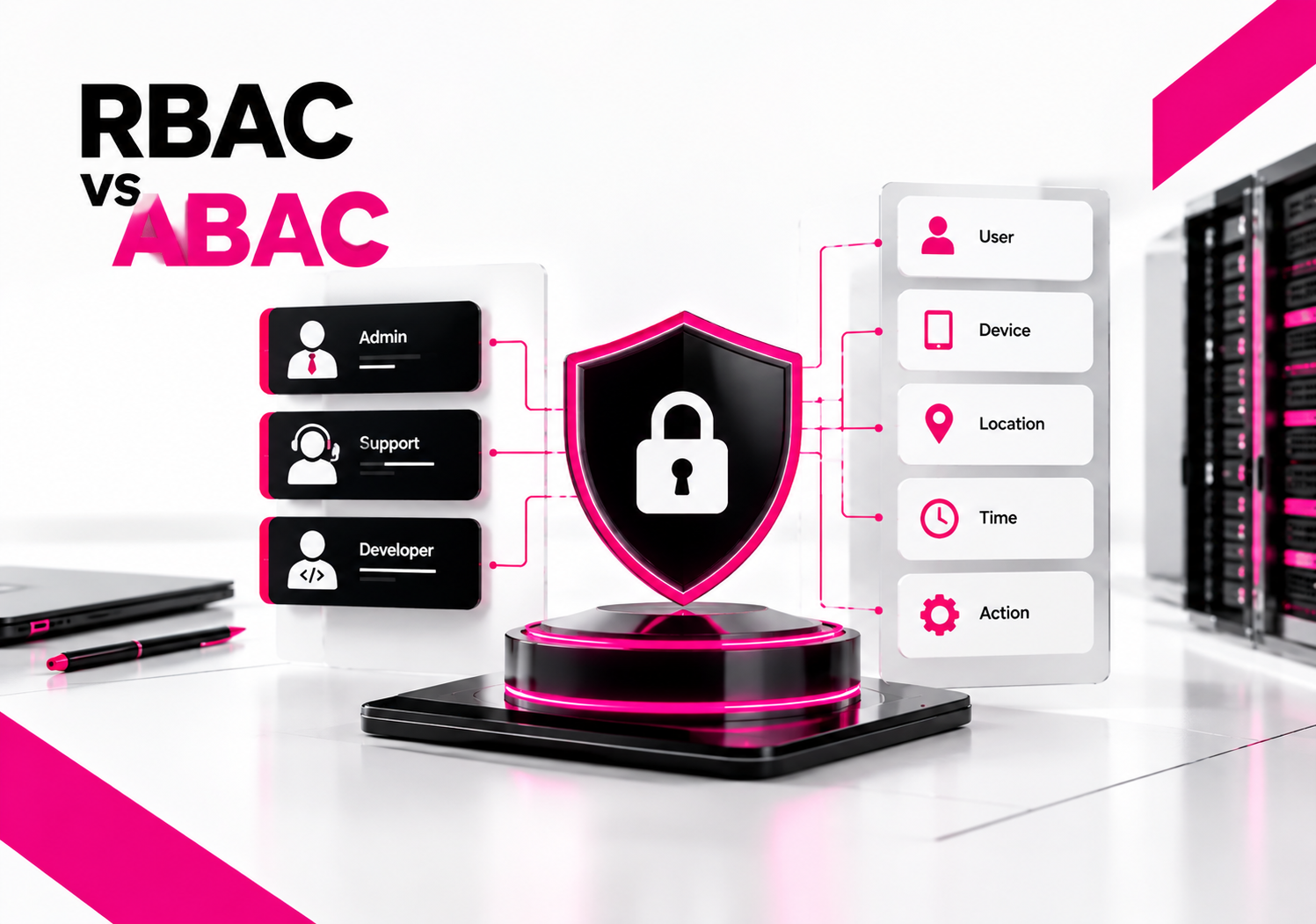
Role-based access control (RBAC) grants permissions through predefined roles, while attribute-based access control (ABAC) evaluates attributes about the user, resource, action, and environment against policies. RBAC is usually simpler to administer, while ABAC provides finer-grained decisions for dynamic environments. Many organizations can use RBAC for baseline permissions and ABAC rules for context-sensitive access.
Access control becomes difficult when an organization has hundreds of applications, thousands of users, cloud resources, contractors, devices, and constantly changing business conditions. The basic question is no longer simply “Who is this user?” It becomes “Should this specific request be allowed right now?”
That distinction explains the difference between role-based access control vs attribute-based access control. RBAC makes authorization easier to manage by associating permissions with roles. ABAC evaluates multiple attributes and policy conditions before making an authorization decision.
Neither model is automatically appropriate for every environment. The better choice depends on how stable your permissions are, how much context your policies require, and how much complexity your security team can operate reliably.
What is RBAC?
RBAC, or role-based access control, assigns permissions to roles rather than directly to individual users. Users are then assigned appropriate roles, and their effective permissions come from those roles. NIST describes RBAC as a model where permitted actions on resources are identified with roles rather than individual identities.
For example, a SaaS company might define:
| Role | Typical permissions |
|---|---|
| Support Agent | View customer tickets and basic account data |
| Developer | Access development systems and source repositories |
| Finance | Access billing and financial records |
If an employee moves from support to engineering, the administrator can change the employee’s role instead of manually modifying dozens of individual permissions.
This centralized model is one of RBAC’s biggest advantages. NIST’s early RBAC research specifically identified the ability to associate permissions with roles and move users between roles without restructuring the underlying authorization model.
How does RBAC work?
A basic RBAC authorization flow looks like this:
User → Role → Permission → Resource
Imagine Alice is assigned the HR_Manager role. That role might contain permissions to:
- Read employee records
- Update employee records
- Approve certain HR requests
- Access HR reporting systems
Alice doesn’t receive each permission individually. The role acts as the management layer between her identity and the resources.
RBAC can also support role hierarchies and separation-of-duty controls. For example, an organization might prevent a user who submits a purchase request from also approving that same request.
What is ABAC?
ABAC, or attribute-based access control, evaluates attributes and policies to determine whether a particular request should be allowed. NIST SP 800-162 defines ABAC around attributes associated with the subject, object, requested operation, and potentially environmental conditions.
Instead of asking only:
“Is this user an administrator?”
an ABAC policy can ask:
“Is this user an administrator, accessing this type of data, from an approved device, from an allowed location, during an approved period, and performing an authorized action?”
A simplified ABAC decision could look like:
ALLOW
IF
user.department = "Finance"
AND user.clearance = "Confidential"
AND resource.classification = "Confidential"
AND device.managed = true
AND request.action = "read"
The policy engine evaluates the attributes and conditions before returning an authorization decision.
NIST notes that ABAC can evaluate subject, object, action, and environmental attributes, giving organizations considerably more flexibility than a model based only on predefined roles.
RBAC vs ABAC: What is the main difference?
The central difference is what drives the authorization decision. RBAC primarily uses predefined organizational roles, while ABAC evaluates attributes and policy conditions associated with the request.
| Factor | RBAC | ABAC |
|---|---|---|
| Main decision factor | User role | Attributes and policy |
| Policy complexity | Lower | Higher |
| Dynamic conditions | Limited unless combined with other controls | Strong |
| Administration | Generally simpler | Requires stronger policy/attribute management |
Consider an employee accessing a confidential document.
With RBAC, the rule might be:
Finance_Manager → Read Confidential ReportsWith ABAC, the rule could be:
department = Finance
AND clearance = Confidential
AND device = Managed
AND location = Approved
AND action = Read
The second approach can express more conditions without creating a separate role for every combination.
Is ABAC more flexible than RBAC?
Yes, ABAC generally provides more policy flexibility because authorization can depend on multiple attributes and environmental conditions. NIST describes ABAC as capable of evaluating relationships among subject, object, action, and environmental attributes rather than relying solely on predefined roles.
That flexibility matters when access decisions change according to context.
For example, suppose a healthcare application allows employees to access records only when:
- They are assigned to the relevant department.
- They have the required clearance.
- The patient relationship is valid.
- The device meets security requirements.
- The requested operation is permitted.
Trying to represent every combination with RBAC can produce an increasingly large collection of specialized roles.
NIST researchers have specifically discussed role explosion as a limitation that can appear when RBAC is stretched to represent dynamic attributes and many combinations of permissions.
But flexibility comes with operational cost. ABAC requires reliable attributes, consistent policy definitions, policy testing, and mechanisms for establishing, updating, validating, and revoking those attributes. NIST explicitly identifies attribute management as a major consideration for ABAC deployments.
Is RBAC easier to manage than ABAC?
For many organizations, yes. RBAC is easier when access requirements map naturally to stable job functions.
Imagine a 100-person company with a small IT team. It might have roles such as:
- Sales
- Support
- Engineering
- Finance
- HR
- Administrator
Each role can receive a defined set of permissions. When someone changes departments, their role changes.
The model is relatively easy to explain during access reviews:
“This person has these permissions because they have this role.”
ABAC requires administrators to understand not only permissions but also the attributes and relationships used by policies.
That means ABAC governance can become more complicated even though the resulting authorization decisions are more precise.
Does RBAC have a role explosion problem?
It can. Role explosion happens when administrators create increasingly specific roles to represent combinations of users, resources, locations, projects, or circumstances.
For example, an organization might start with:
FinanceThen it needs:
Finance-US
Finance-EU
Finance-Managers
Finance-Contractors
Finance-US-Managers
Finance-EU-Managers
Finance-US-Contractors
Eventually, roles become difficult to understand and maintain.
NIST research on adding attributes to RBAC identified this exact tension: dynamic attributes can make a pure RBAC implementation less flexible, potentially requiring very large numbers of roles to represent different permission combinations.
ABAC can reduce this problem by expressing some of those differences as attributes instead.
For example:
department = Finance
region = EU
employment_type = Contractor
A policy can evaluate those values without requiring a unique role for every combination.
When should you use RBAC?
RBAC is a strong fit when permissions closely follow organizational responsibilities. It works particularly well when job functions are predictable and access requirements don’t change frequently based on context.
Good RBAC use cases include:
- Internal business applications
- SaaS administration
- Database administration
- Developer platforms
- Help-desk systems
- Standard employee permissions
- Applications with clear job functions
A practical RBAC design starts with business responsibilities rather than individual employees.
Instead of creating:
Alice-Permissions
Bob-Permissions
Carol-Permissions
create meaningful roles such as:
Support-Agent
Support-Manager
Developer
Security-Administrator
Finance-Analyst
Then assign users to those roles.
This makes access reviews considerably easier because reviewers can reason about roles instead of thousands of individual permission assignments.
When should you use ABAC?
ABAC becomes particularly useful when authorization depends on context that cannot be represented cleanly by a small set of stable roles.
Examples include:
- Data classification
- Geographic restrictions
- Device security state
- Time-based access
- Project membership
- Customer ownership
- Contractor status
- Regulatory requirements
- Resource sensitivity
- Transaction type
For example, an organization might permit an employee to download a sensitive file only when:
employee.department = resource.department
AND
device.managed = true
AND
resource.classification <= employee.clearance
AND
download_allowed = true
That is a natural ABAC-style policy because the decision depends on multiple attributes.
NIST’s ABAC guidance specifically describes the use of subject, object, action, and environmental attributes to make these kinds of policy decisions.
Can you use RBAC and ABAC together?
Yes. Combining RBAC and ABAC can provide a practical balance between manageable administration and contextual authorization.
A common architecture is:
Identity
   ↓
Role
   ↓
Baseline permissions
   ↓
ABAC policy evaluation
   ↓
Contextual authorization decision
For example, a user might have the Finance-Analyst role. That role establishes their baseline permissions, while ABAC policies impose additional conditions:
Role = Finance-Analyst
AND
Device = Managed
AND
Data Classification = Allowed
AND
Request Time = Business Hours
The result is more granular than using roles alone without forcing the organization to create a separate role for every possible context.
NIST has also published research specifically exploring how attributes can be added to RBAC to address dynamic access requirements.
Which is better for cloud environments: RBAC or ABAC?
Cloud environments can use either model, but ABAC-style conditions become particularly useful as resources, identities, devices, and contexts become more dynamic. RBAC remains useful for establishing straightforward administrative boundaries and job-function permissions.
A practical cloud design often starts with clear roles and then adds contextual policies where the business requirement genuinely demands them.
For example:
Role:
Security Analyst

Baseline access:
Read security alerts
Read logs
Investigate incidents

Additional policy:
Allow access only from managed devices
This avoids turning every contextual difference into another role.
The exact implementation depends on the cloud platform and authorization system. AWS IAM, Microsoft Azure, Google Cloud IAM, Kubernetes RBAC, and application-level authorization systems all implement access control differently, so their terminology and available policy conditions should be checked against the relevant vendor documentation.
How do you choose between RBAC and ABAC?
Start by asking whether your authorization requirements can be described using stable business roles.
If the answer is yes, RBAC may provide the simpler operating model. If access depends heavily on dynamic context, ABAC can express those policies without multiplying roles.
Use this checklist:
1. List your resources
Identify databases, applications, APIs, files, cloud resources, administrative interfaces, and other protected assets.
2. Identify normal job functions
Create roles based on actual responsibilities rather than individual users.
3. Document sensitive access conditions
Look for requirements involving:
- Location
- Device state
- Time
- Data classification
- Project
- Department
- Clearance
- Resource ownership
4. Look for role explosion
If you are creating dozens of nearly identical roles just to represent contextual differences, evaluate whether those differences belong in attributes and policies.
5. Establish attribute ownership
For ABAC, determine where attributes originate and who can change them. NIST stresses that attributes need processes for establishment, storage, validation, updating, security, and revocation.
6. Test policies before production
Authorization policies should be tested against both allowed and denied scenarios.
A useful test matrix includes:
Correct user + correct resource     → Allow
Correct user + wrong resource       → Deny
Wrong department + correct role     → Deny
Managed device                      → Allow
Unmanaged device                    → Deny
Expired attribute                   → Deny
The objective is not simply to prove that legitimate access works. Negative authorization tests are equally important.
What are the security trade-offs between RBAC and ABAC?
RBAC’s main advantage is simplicity, but simplicity can become restrictive when access requirements become highly contextual. ABAC provides more precise policies, but the added flexibility creates more dependencies on accurate attributes and correctly designed policy logic.
A useful way to think about the trade-off is:
RBAC reduces policy complexity by simplifying the decision model. ABAC increases policy expressiveness but requires stronger governance around attributes and rules.
Neither model eliminates the need for least privilege, access reviews, identity lifecycle management, logging, and policy testing.
A badly configured ABAC policy can still grant excessive access. A badly designed RBAC role can do the same.
The access-control model is only one part of the security architecture.
RBAC vs ABAC: Which should you implement?
For a straightforward organization with stable job functions, start with RBAC and keep the role catalog small, understandable, and tied to actual responsibilities.
For environments where access depends heavily on data sensitivity, device posture, location, project membership, or other changing conditions, add ABAC policies where those conditions genuinely matter.
In many mature environments, the practical answer is not RBAC versus ABAC. It is RBAC for stable baseline permissions plus ABAC for contextual restrictions.
The key is to avoid introducing ABAC simply because it is more flexible. More flexibility also means more policy logic to design, test, monitor, and maintain.
Frequently Asked Questions
What is the difference between RBAC and ABAC?
RBAC makes authorization decisions primarily through assigned roles, such as Developer or Finance Manager. ABAC evaluates attributes and policy conditions involving the user, resource, requested action, and environment. RBAC is generally easier to manage, while ABAC can express more dynamic and granular authorization requirements.
Is ABAC more secure than RBAC?
Neither ABAC nor RBAC is inherently more secure in every implementation. ABAC can enforce more contextual conditions, while RBAC can provide a simpler and easier-to-audit permission structure. Security depends on correct policy design, least privilege, attribute quality, lifecycle management, monitoring, and regular access reviews.
When should I use RBAC instead of ABAC?
Use RBAC when access maps cleanly to stable job responsibilities and you can maintain a manageable number of roles. Typical examples include internal applications, SaaS administration, support systems, and business platforms where employees consistently need similar permissions based on their functions.
Can RBAC and ABAC be used together?
Yes. An organization can use RBAC to establish baseline permissions and ABAC to apply additional contextual conditions. For example, a Finance Analyst role could provide access to financial systems while an ABAC policy requires a managed device and appropriate data classification before sensitive records can be accessed.
What causes role explosion in RBAC?
Role explosion occurs when organizations create increasingly specific roles to represent combinations of permissions, departments, projects, locations, or other conditions. NIST research identifies dynamic attributes as one reason a pure RBAC design can become difficult to scale, because many combinations may require separate roles.
Is ABAC difficult to implement?
ABAC can be more difficult to govern because organizations must define reliable attributes, establish policy rules, manage attribute lifecycle, and test authorization decisions. NIST specifically highlights the need to establish, validate, update, secure, and revoke attributes as part of an ABAC implementation.
Final Takeaway
RBAC and ABAC solve the same fundamental problem—controlling access—but they approach authorization differently. RBAC organizes permissions around stable roles; ABAC evaluates attributes and context to make more granular decisions.
The practical next step is to audit your existing roles. If most permissions map cleanly to job functions, keep RBAC simple. If you’re creating large numbers of roles to represent changing conditions, identify those conditions as candidate attributes and evaluate an RBAC-plus-ABAC model.