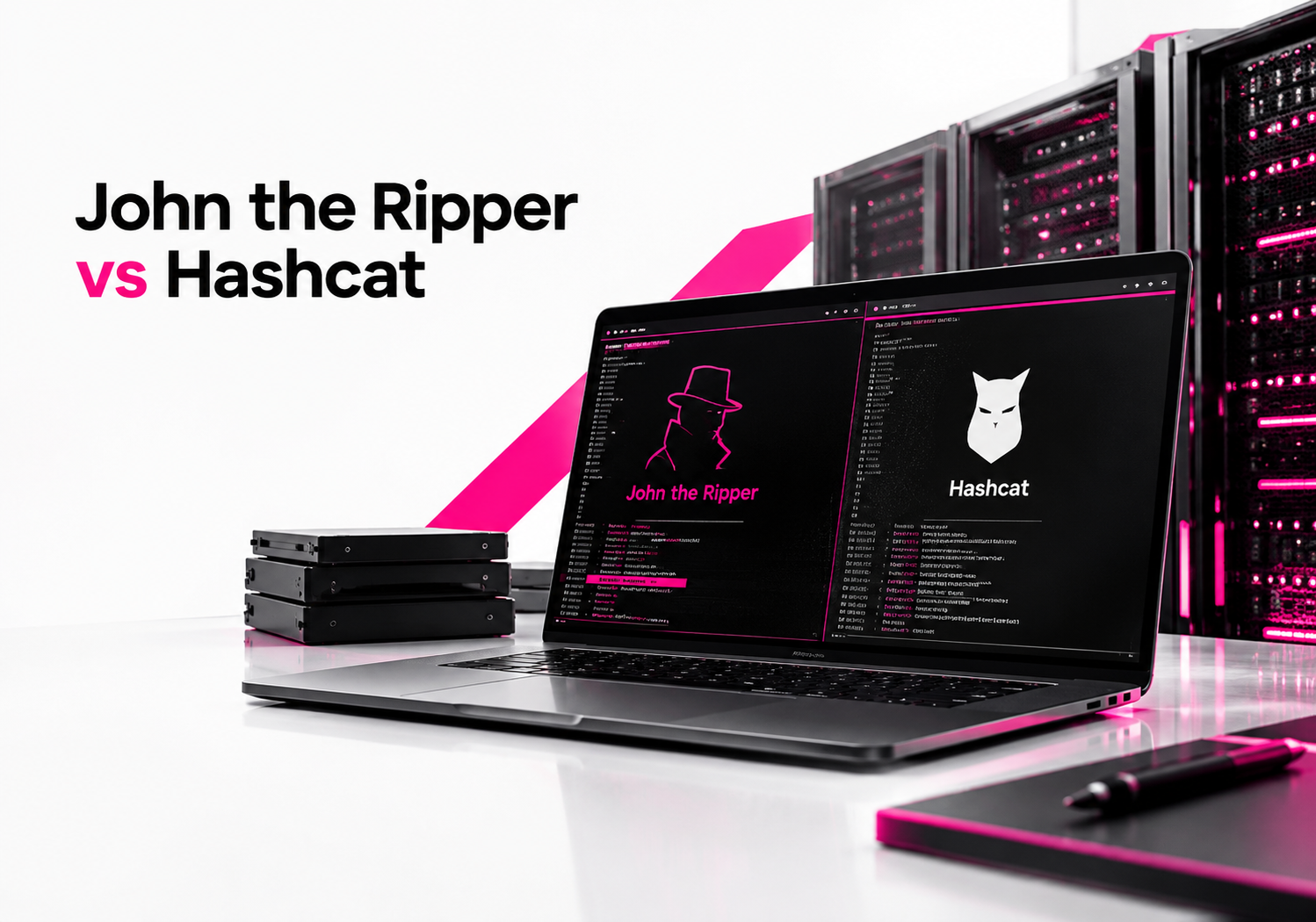
John the Ripper and Hashcat are both powerful password-cracking and security-auditing tools, but they excel in different areas. Hashcat is usually the better choice for GPU-accelerated password recovery and large-scale hash testing, while John the Ripper is exceptionally flexible for identifying hash types, working with complex password formats, and using sophisticated word-mangling rules.
The right choice depends less on which tool is “stronger” and more on the hashes, hardware, attack strategy, and evidence available to you. Hashcat’s attack-mode model makes systematic GPU-based testing straightforward, while John the Ripper’s broad format support and cracking modes make it particularly useful during password audits and forensic work.
Both tools should be used only against passwords or hashes you are authorized to test. In a legitimate security assessment, they can reveal weak password choices before an attacker does.
What is the difference between John the Ripper and Hashcat?
The biggest difference is their design emphasis: Hashcat is heavily optimized around high-performance password recovery, especially with GPUs, while John the Ripper focuses on broad format support, flexible cracking modes, and password-analysis workflows.
John the Ripper, commonly abbreviated as JtR, has been around for decades and supports many password hash and encrypted-file formats. The Openwall documentation describes the Jumbo version as supporting hundreds of additional hash and cipher types, including Windows NTLM, web-application hashes, encrypted archives, SSH private keys, and several encrypted document formats.
Hashcat takes a different approach. Its official documentation organizes password attacks into explicit modes such as dictionary, combinator, mask, hybrid, and rule-based attacks.
That distinction matters when choosing a tool.
| Area | John the Ripper | Hashcat |
|---|---|---|
| Main strength | Flexibility and format coverage | High-performance password recovery |
| Best fit | Audits, unusual formats, CPU/GPU workflows | GPU-heavy hash cracking and systematic attacks |
| Attack model | Multiple cracking modes and configurable rules | Explicit attack modes with extensive GPU support |
Neither tool automatically “decrypts” a password hash. They generate candidate passwords, hash those candidates using the appropriate algorithm, and compare the resulting value with the target hash.
Is Hashcat faster than John the Ripper?
Hashcat can be substantially faster when a supported hash workload benefits from GPU acceleration, but there is no universal winner for every hash type or hardware configuration.
A benchmark for one algorithm should not be treated as a benchmark for all algorithms. Password-hashing algorithms such as Argon2id and bcrypt deliberately introduce computational or memory costs that change the economics of cracking.
Hashcat’s strength is its ability to exploit suitable GPU hardware and divide large candidate spaces into highly parallel workloads. That makes it particularly attractive when an assessment involves a large number of candidates or a hash type with efficient GPU implementation.
John can also use hardware acceleration depending on the build and format. Its documentation describes CPU-oriented modes such as incremental cracking and wordlist rules, while the Jumbo ecosystem adds substantial format support.
So the practical answer is:
Use Hashcat when raw GPU throughput is central to the job. Use John when format support, password transformation rules, and flexible analysis are more important.
Which tool supports more password hash types?
John the Ripper is often the more convenient choice when you encounter an unfamiliar or unusual password format, especially because its Jumbo version supports a very broad range of hashes, encrypted files, and related formats.
This is one of John’s biggest advantages.
The Openwall documentation lists support for traditional Unix password hashes, Kerberos/AFS, Windows LM hashes, NTLM, raw MD5 and SHA families, SQL and LDAP password hashes, SSH private keys, encrypted archives, macOS disk images, and encrypted Office/PDF files among its supported Jumbo capabilities.
Hashcat also supports a very large number of hash types, but its workflow often starts with identifying the correct hash mode and then selecting the corresponding attack mode.
For a penetration tester dealing with a strange credential artifact, John can therefore be a convenient first tool.
Which is better for GPU password cracking?
Hashcat is generally the stronger first choice for GPU-focused password cracking because its architecture and attack modes are designed around highly parallel candidate generation and computation.
A modern GPU can evaluate huge numbers of candidates in parallel for algorithms that are suitable for GPU acceleration. Hashcat’s official documentation includes dictionary, combinator, mask, hybrid, association, and rule-based attack approaches.
For example, a security tester might know that an organization’s passwords commonly follow a pattern such as:
CompanyName + four digitsA mask-based strategy can test that constrained candidate space instead of blindly attempting every possible password.
This is much more efficient than a naïve brute-force approach.
The important caveat is the hash algorithm. A fast hash such as an old unsalted MD5 password hash is fundamentally different from a properly configured Argon2id password hash. Comparing raw candidate-per-second figures across those two situations can produce a very misleading picture.
Is John the Ripper better for wordlists and password rules?
John the Ripper is particularly strong when a password audit depends on transforming realistic words into likely password candidates.
John supports wordlist mode with password-mangling rules. Its official documentation explains that rules can transform each word in a wordlist into multiple candidate passwords.
That is useful because real passwords are rarely random strings.
A company password policy might produce patterns such as:
Summer2024
Summer2025
Summer2026!
CompanyName123
CompanyName!
A security assessment can use a permitted organizational wordlist and carefully designed rules to test whether employees are making predictable modifications.
John also has a “single crack” mode that can use information associated with accounts, such as login names and full-name fields, combined with password-mangling rules.
That makes John’s workflow particularly interesting for targeted password auditing.
How do John the Ripper and Hashcat handle different attack types?
Both tools support multiple password-generation strategies, but Hashcat exposes its attack strategies through a particularly clear attack-mode system, while John’s workflow is organized around cracking modes and configurable rules.
Hashcat’s documented modes include:
- Dictionary attacks
- Combinator attacks
- Mask attacks
- Hybrid attacks
- Rule-based attacks
- Association attacks
Its mask mode is useful when you know something about password structure, while hybrid attacks combine wordlists and masks.
John provides wordlist, single-crack, incremental, and external modes. Its incremental mode can attempt character combinations according to predefined character-frequency models rather than simply walking through combinations in a naïve order.
When should you use a dictionary attack?
Use a dictionary attack when you have a high-quality candidate list and believe passwords are based on recognizable words, names, products, places, or previously exposed passwords.
A dictionary attack is usually much more efficient than unrestricted brute force because it prioritizes candidates that have a realistic chance of being correct.
When should you use a mask attack?
Use a mask when you know part of the password structure.
For example, if an authorized audit establishes that passwords follow a known pattern, a mask can test only the unknown characters rather than wasting computation on impossible candidates.
This is one of Hashcat’s most useful capabilities.
How do you use John the Ripper safely in a password audit?
Start by confirming authorization, identify the hash format, preserve the original evidence, and begin with the least expensive realistic attack before escalating to broader candidate generation.
A sensible workflow is:
- Define the scope. Confirm exactly which systems, accounts, and hashes you are authorized to test.
- Preserve the evidence. Keep the original hash file unchanged and work from a controlled copy.
- Identify the format. Determine the password-hashing algorithm before selecting a cracking strategy.
- Start with realistic candidates. Use an approved organizational wordlist or other authorized candidate source.
- Apply rules carefully. Test common transformations before attempting huge search spaces.
- Use targeted masks when appropriate. Constrain unknown characters based on evidence rather than guessing blindly.
- Record results. Document the recovered-password category, attack method, and defensive recommendation.
- Stop when the assessment objective is met. Password auditing is not improved simply by running a cracking job indefinitely.
John’s documentation supports explicit format selection with --format, wordlists with --wordlist, password rules with --rules, and resumable sessions with --restore.
For example, an authorized lab exercise might begin with:
john --wordlist=passwords.txt --rules hashes.txtThe exact command depends on the hash format and the tool build. Do not copy a command blindly into a production environment.
How do you use Hashcat safely in a password audit?
Hashcat works best when you first identify the hash mode and then choose an attack strategy based on what you actually know about the password construction.
A practical process looks like this:
- Identify the hash algorithm.
- Confirm that the Hashcat mode matches that algorithm.
- Begin with a controlled dictionary.
- Add rules to model realistic password modifications.
- Use masks when password structure is known.
- Use hybrid strategies when you know both a word component and an unknown character component.
- Monitor resource usage and stop unnecessary jobs.
- Document the security finding rather than treating the recovered password as the end goal.
The goal of an audit is not to collect passwords. The goal is to demonstrate whether the organization’s password storage and password-selection practices resist realistic offline attacks.
That distinction matters because a weak password discovered during an assessment is evidence of a security problem that should be fixed, not a trophy.
Which tool should penetration testers choose?
For a penetration tester who has both tools available, the best approach is not to choose one permanently: use John the Ripper for broad format handling and flexible password analysis, and Hashcat when GPU-intensive candidate testing is the priority.
A practical toolkit can contain both.
Choose John the Ripper first when:
- The credential artifact is unusual.
- You need broad format support.
- Password-mangling rules are central to the assessment.
- You are working with encrypted archives or other supported non-password-hash artifacts.
- You want a flexible command-line password-auditing workflow.
Choose Hashcat first when:
- You have a capable GPU.
- The hash type is well supported.
- You need high-throughput candidate testing.
- Mask or hybrid attacks fit the evidence.
- You want explicit control over attack modes.
In many professional assessments, the question is not “John or Hashcat?” It is “Which tool fits this evidence?”
What does password cracking tell you about password security?
A successful crack demonstrates that an attacker with the relevant password hash could make a successful offline guess; it does not necessarily mean the hashing algorithm itself has been broken.
This distinction is crucial.
OWASP recommends modern password-hashing algorithms such as Argon2id, scrypt, or bcrypt rather than fast general-purpose hashes. It also recommends unique salts because salts prevent attackers from efficiently reusing precomputed password-hash tables across accounts.
NIST likewise says verifiers should store memorized secrets in a form resistant to offline attacks and use salted one-way key-derivation functions. NIST also recommends memory-hard functions where appropriate because they increase the cost of guessing attacks.
This is why replacing SHA-256 with “more complicated” password cracking rules is not a defensive strategy.
The better defense is to use an appropriate password-storage design in the first place.
John the Ripper vs Hashcat: Which one should you use?
If you want one general recommendation, start with Hashcat for modern GPU-focused password recovery and keep John the Ripper available for its exceptional format coverage and flexible password-auditing features. For serious security work, knowing both is more valuable than treating them as competitors.
For a small password audit, either tool can be sufficient. For a professional penetration-testing workflow, having both lets you change strategy when the hash format, hardware, or password evidence changes.
There is also a defensive lesson: if a password database can be cracked quickly with commodity hardware, the organization should not respond by simply banning one cracking tool. It should review password hashing, salting, password policy, authentication controls, and credential exposure.
FAQ: John the Ripper vs Hashcat
Is Hashcat better than John the Ripper?
Hashcat is generally better for GPU-heavy password recovery and systematic mask, hybrid, and rule-based attacks. John the Ripper is often more convenient for unusual formats, broad credential-artifact support, and sophisticated password-mangling workflows. For professional security testing, keeping both tools available is usually the most practical approach.
Is John the Ripper still useful?
Yes. John remains highly useful for password auditing, especially when dealing with diverse hash formats and password-derived artifacts. Its Jumbo version supports hundreds of additional hash and cipher types, while its cracking modes include wordlist, single-crack, incremental, and external modes.
Can Hashcat crack any password hash?
No. Hashcat supports many algorithms, but support for a particular format does not mean every password can be recovered. Strong, randomly generated passwords combined with properly configured memory-hard password hashing can make exhaustive guessing economically impractical. The difficulty depends on the algorithm, parameters, password entropy, candidate space, and available hardware.
Which is easier for beginners, John the Ripper or Hashcat?
John can be easier for some beginners because its basic workflow is straightforward and it can automatically detect supported formats in many situations. Hashcat can have a steeper learning curve because users need to understand hash modes and attack modes, but its structured attack model becomes very powerful once those concepts are familiar.
Does password cracking mean the encryption was broken?
No. Password cracking usually means an attacker found a password candidate that produces the same stored password hash. The underlying cryptographic algorithm may remain completely intact. The weakness may instead be a predictable password, weak password storage, inadequate hashing parameters, or leaked credential material.
Related reading: Hydra vs Medusa and PBKDF2 vs Argon2id. Browse all our cybersecurity comparisons.
Final verdict: John the Ripper or Hashcat?
John the Ripper and Hashcat solve overlapping problems, but they are optimized for different workflows.
Choose Hashcat when GPU performance and structured password-generation attacks are your priority. Choose John the Ripper when format coverage, password-mangling flexibility, or unusual credential artifacts matter more.
For a serious security lab, install both and learn their strengths. Then choose the tool based on the hash, hardware, and evidence—not brand loyalty.
The next practical step is simple: take an authorized test hash in a controlled lab, identify its algorithm, and compare a targeted wordlist attack with a rule- or mask-based strategy. That exercise teaches far more than memorizing which tool has the bigger benchmark number.