Author: Cyber Snowden Editorial Team

The Cyber Snowden Editorial Team researches, writes and reviews guides on cybersecurity threats, tools, frameworks and careers. Every article is checked against official sources such as NIST, CISA and vendor documentation, and updated when standards or products change. Our goal is practical, plain-language security advice for business and IT teams.

Lessons from Cyber Security and the Toyota Production System

Summary Recent cyber incidents impacting Toyota’s global operations highlight a growing need to merge operational excellence with cyber resilience. By examining Toyota’s Production System (TPS) and recent supply chain attacks, businesses can adopt smarter, more robust security strategies. Understanding the Toyota Production System The Toyota Production System (TPS) is world-renowned for its focus on eliminating waste, improving efficiency, and ensuring quality. Built on two core principles—Just-in-Time and Jidoka (automation with a human touch)—TPS is deeply rooted in continuous improvement and problem-solving at the source. TPS relies on a finely tuned supply chain, where any disruption can impact the entire production…

Read More
Cyber Security One Word or Two

Summary People often ask if it should be cybersecurity (one word) or cyber security (two words). While both appear online, style guides, governments, and technology leaders now overwhelmingly prefer cybersecurity as a single word. This guide explains why, with examples from dictionaries, official sources, and industry practice. Why the Confusion Exists Language evolves over time. In the early days of the internet, writers separated terms like cyber space or web site. Over time, frequent use led to merged forms such as cyberspace, website, and cybersecurity. You may still see cyber security in older documents, UK publications, or some degree titles.…

Read More
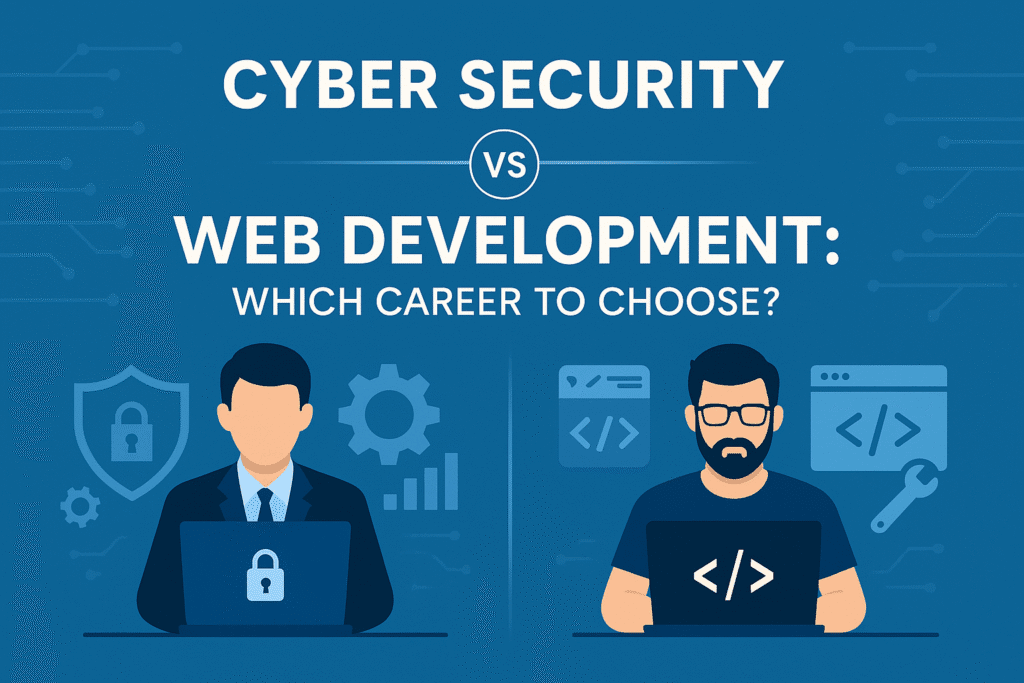
Cyber Security vs Web Development

Summary Cyber security and web development are two of the most popular IT careers today. Both offer strong demand, good salaries, and growth opportunities, but they suit different skills and interests. This guide compares the two paths to help you decide which fits your goals. Understanding Cyber Security Cyber security professionals protect systems, networks, and data from cyber threats. Their work includes monitoring, ethical hacking, risk management, and ensuring compliance with security standards. For example, a security analyst may investigate suspicious activity in a company’s network, while a penetration tester looks for weaknesses before criminals exploit them. The role requires…

Read More
How to Prepare for a Cyber Security Job

Summary Attending a cyber security job fair in 2025 can be a turning point in your career. With the right preparation, you can make a strong impression on employers, grow your network, and secure interviews for competitive roles. Why Cyber Security Job Fairs Matter Cyber security job fairs bring together employers, recruiters, and training providers under one roof. They are an efficient way to meet multiple hiring managers, explore career paths, and learn about industry needs. With cyber security skills in high demand, job fairs also provide candidates with insights into the latest tools, certifications, and trends shaping the sector.…

Read More
Meta Title: Cyber Security Health Check Guide for Businesses Meta Description: Discover what a cyber security health check is, why businesses need it, and how it strengthens digital defences. What Is a Cyber Security Health Check and Why Businesses Need It Summary Cyber security health checks help organisations uncover weaknesses in their defences before attackers exploit them. By identifying risks, ensuring compliance, and providing clear improvement plans, businesses can build resilience and maintain trust with clients. What is a Cyber Security Health Check? A cyber security health check is a comprehensive assessment of your organisation’s digital defences. It evaluates networks, systems, policies, and processes to uncover vulnerabilities. Think of it as a routine medical exam for your IT environment. Instead of spotting physical issues, it highlights weak points in cyber protection, from outdated software to poor incident response plans. Most assessments align with recognised frameworks such as NIST or NCSC, giving businesses a benchmark against industry standards. Why Businesses Need a Cyber Security Health Check Cyber threats are becoming more frequent and more sophisticated. Even with security measures in place, blind spots often exist that only an external review can identify. Key reasons businesses invest in cyber health checks: Rising threat levels: UK businesses are attacked daily through phishing, ransomware, and malware. Compliance pressure: Regulations such as GDPR and Cyber Essentials require strong security practices. Business continuity: A breach can halt operations and damage reputation. Proactive defence: Early detection prevents costly incidents and builds resilience. What Does a Cyber Security Health Check Include? A health check provides an in-depth report on your current security posture. It typically covers: Cyber risk management: Understanding threats that pose the biggest risk to your business. Technical controls: Firewalls, endpoint protection, and patch management effectiveness. Vulnerability scans: Identifying weak points in systems and networks. Incident response readiness: How well your business can detect, respond, and recover. Compliance checks: Ensuring your practices align with data protection and regulatory standards. Staff awareness: Recommendations for training to reduce human error in security breaches. Cyber Health Check vs Cyber Security Audit While both provide value, they differ in depth and focus. Option Key features Best for Cyber Security Audit One-time review of IT infrastructure, real-time analysis, snapshot of security posture Businesses seeking a compliance check or basic risk review Cyber Security Health Check Ongoing, in-depth evaluation including vulnerability scans, risk management, incident response planning Organisations seeking a proactive and strategic improvement plan Managed Security Assessment Continuous monitoring, threat detection, consultancy support Businesses with high regulatory requirements or complex IT environments When Should a Business Get a Cyber Security Health Check? Experts recommend conducting one at least every 6–12 months. You should also arrange a check when: Deploying new IT systems or software. Expanding into cloud services. Handling sensitive customer or financial data. Experiencing rapid growth or organisational change. Regular reviews ensure your business adapts as threats evolve. Conclusion A cyber security health check is not just a compliance exercise. It is a proactive strategy that protects your business from costly breaches, ensures regulatory alignment, and strengthens client trust. By uncovering vulnerabilities and providing a clear roadmap, it allows organisations to stay resilient in a constantly changing threat landscape. Frequently Asked Questions What is the main purpose of a cyber security health check? To identify vulnerabilities and provide actionable recommendations that strengthen your organisation’s security posture. How often should a business carry out a health check? At least once a year, but more frequently if major IT changes or compliance updates occur. Who performs a cyber security health check? Specialist cyber security consultants or managed service providers with expertise in frameworks like NIST and ISO27001. Is a health check different from penetration testing? Yes. Penetration testing simulates attacks on specific systems, while a health check provides a broader assessment of overall cyber resilience. Does a cyber health check help with GDPR compliance? Yes. It highlights gaps in data protection practices, helping businesses align with GDPR and similar regulations. How long does a cyber security health check take? This varies by business size but typically ranges from a few days to several weeks depending on scope. Can small businesses benefit from a cyber health check? Absolutely. Small firms are often targeted due to weaker defences, making regular checks essential.

Summary Cyber security health checks help organisations uncover weaknesses in their defences before attackers exploit them. By identifying risks, ensuring compliance, and providing clear improvement plans, businesses can build resilience and maintain trust with clients. What is a Cyber Security Health Check? A cyber security health check is a comprehensive assessment of your organisation’s digital defences. It evaluates networks, systems, policies, and processes to uncover vulnerabilities. Think of it as a routine medical exam for your IT environment. Instead of spotting physical issues, it highlights weak points in cyber protection, from outdated software to poor incident response plans. Most assessments…

Read More
The Ultimate Guide to Cyber Security

Summary Cybersecurity is filled with abbreviations that can feel overwhelming for newcomers and even seasoned professionals. This guide breaks down the most important acronyms in 2025, grouped by domain, with definitions and practical examples to make them easy to understand and apply in real scenarios. Why Acronyms Matter in Cybersecurity Acronyms simplify technical discussions and speed up communication between IT teams. Security reports, compliance frameworks, and incident response playbooks all rely heavily on shorthand. Understanding them helps professionals act quickly, make informed decisions, and avoid misinterpretation. For instance, when a Security Operations Centre (SOC) analyst talks about SIEM, they are…

Read More
Basic Cyber Security for Employees

Summary Cybersecurity is no longer optional for small businesses. Employees are often the first line of defence against online threats. By implementing a structured onboarding checklist, businesses can reduce risks, protect data, and foster a culture of security from day one. Why Small Businesses Must Prioritise Cybersecurity Onboarding Small businesses are frequent targets of cyber-attacks because they often lack dedicated IT teams. Phishing emails, weak passwords, and outdated devices can all lead to costly breaches. Training employees during onboarding ensures new hires understand their role in protecting sensitive information. Key Elements of an Employee Cybersecurity Onboarding Checklist Understanding Security Policies…

Read More
Best AI Website Builder

Summary AI website builders are transforming how businesses and creators launch websites. They combine automation, design flexibility, and speed to deliver professional results without coding. This guide compares the best AI website builders for 2025, their features, and use cases to help you choose wisely.   Best AI Website Builders in 2026 Why AI Website Builders Matter AI has made website creation faster and more accessible. Instead of starting with blank templates, these tools generate layouts, content, and even SEO-ready elements in minutes. For small businesses, freelancers, and entrepreneurs, they save time and reduce costs while delivering professional results.…

Read More
Cyber Security SEO Case Study

Summary In today’s competitive IT and cybersecurity markets, visibility is often the difference between steady growth and stagnation. This case study explores how strategic SEO can drive organic traffic, strengthen authority, and generate qualified leads for cybersecurity businesses. By combining keyword research, content optimisation, and technical fixes, companies can achieve sustainable growth. Why SEO Matters for Cybersecurity Companies Cybersecurity is one of the most competitive digital industries. Buyers actively search for solutions such as managed detection and response (MDR), penetration testing, or threat intelligence tools. Ranking high for these terms means being visible when prospects are ready to engage. Unlike…

Read More
RIPEMD Cyber Security

Summary RIPEMD is a family of cryptographic hash functions developed in the 1990s as an alternative to early MD-based algorithms. It plays an important role in ensuring data integrity, with applications in blockchain, digital signatures, and file verification. This article explains RIPEMD in cyber security, its strengths, and where it still matters today. What is RIPEMD in Cyber Security? RIPEMD (RACE Integrity Primitives Evaluation Message Digest) is a family of hash functions designed to generate fixed-length outputs from variable input data. Hash functions are essential in cyber security because they make tampering detectable and enable verification of digital information. The…

Read More