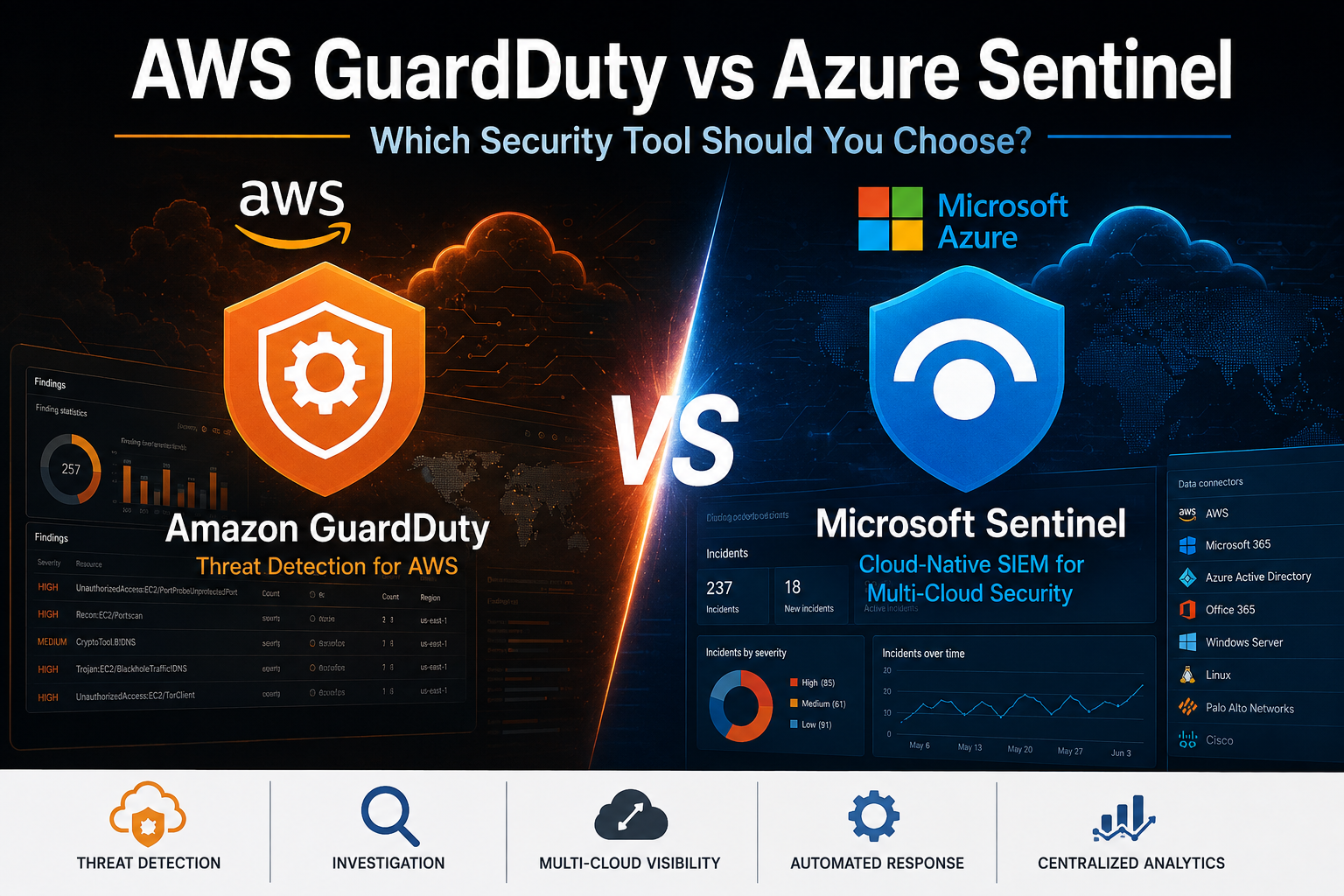
AWS GuardDuty vs Azure Sentinel is not really a choice between two equivalent products. Amazon GuardDuty is primarily a managed threat-detection service built around AWS telemetry, while Azure Sentinel—now called Microsoft Sentinel—is a cloud-native SIEM and security platform designed to collect, correlate, investigate, hunt, and automate response across multiple environments. For AWS-only workloads, GuardDuty is usually the better first security layer. For organizations needing centralized SIEM, cross-cloud visibility, threat hunting, and automated response, Microsoft Sentinel is the stronger choice.
That distinction matters because GuardDuty can detect suspicious AWS activity without requiring you to build a traditional SIEM pipeline. Sentinel, by contrast, becomes more valuable as the number of security data sources grows. Microsoft says Sentinel supports more than 350 native connectors, including AWS sources.
[IMAGE: AWS GuardDuty findings console compared with Microsoft Sentinel incidents dashboard]
What is the difference between AWS GuardDuty and Azure Sentinel?
The simplest difference is this: GuardDuty detects threats inside AWS, while Microsoft Sentinel provides a broader security operations platform for collecting and analyzing security data from AWS, Azure, Microsoft 365, endpoints, on-premises systems, and third-party tools.
Amazon GuardDuty continuously analyzes AWS telemetry such as CloudTrail management events, VPC Flow Logs, DNS logs, EKS audit logs, S3 data events, and workload runtime activity. It uses threat intelligence and machine learning to produce security findings.
Microsoft Sentinel is a SIEM with capabilities for detection, investigation, threat hunting, automation, threat intelligence, UEBA, and response. Microsoft has also expanded Sentinel into a broader security platform with a data lake, security graph, and AI-assisted capabilities.
So comparing them as direct substitutes can lead to the wrong architecture.
Is AWS GuardDuty a SIEM?
No. Amazon GuardDuty is a threat detection service, not a full SIEM.
GuardDuty analyzes AWS security telemetry and generates findings when it identifies potentially malicious or unauthorized behavior. Those findings can then be sent to other AWS services, including Amazon EventBridge and AWS Security Hub, for broader security workflows.
This makes GuardDuty particularly attractive when your main question is:
“Is something malicious happening in my AWS environment?”
For example, GuardDuty can identify suspicious credential use, unusual API activity, compromised EC2 workloads, cryptomining behavior, malicious network communication, and threats involving services such as S3 and EKS.
It has also expanded beyond basic anomaly detection. GuardDuty’s Extended Threat Detection can correlate multiple signals across AWS resources and time to identify multi-stage attack sequences.
That is powerful, but it still doesn’t make GuardDuty a replacement for an enterprise SIEM.
What does Microsoft Sentinel do that GuardDuty does not?
Microsoft Sentinel’s biggest advantage is centralized security visibility.
Sentinel can ingest security data from Microsoft services, AWS, Google Cloud, on-premises infrastructure, and third-party security products. Microsoft currently advertises more than 350 native connectors.
That means a company could send AWS GuardDuty findings into Sentinel and correlate them with:
- Microsoft Entra ID authentication events
- Microsoft Defender alerts
- Windows and Linux logs
- Microsoft 365 activity
- Firewall events
- AWS CloudTrail
- AWS VPC Flow Logs
- AWS GuardDuty findings
- Third-party security products
Microsoft’s AWS connector specifically supports ingestion of GuardDuty findings, CloudTrail, VPC Flow Logs, and CloudWatch data.
This creates an important architectural point: you can use GuardDuty and Sentinel together.
You don’t necessarily have to choose one.
[IMAGE: Architecture diagram showing AWS GuardDuty findings flowing into Microsoft Sentinel alongside Azure, Microsoft 365, and endpoint telemetry]
AWS GuardDuty vs Microsoft Sentinel: Which is better for AWS?
For an AWS-only environment, I would start with GuardDuty.
GuardDuty is deeply integrated with AWS services and understands AWS-specific signals without requiring you to construct a large SIEM ingestion architecture. It also has protection plans covering areas such as S3, EKS, runtime activity, malware, RDS, Lambda, and AI workloads.
For example, AWS introduced GuardDuty AI Protection in 2026 for workloads involving Amazon Bedrock and SageMaker. It is designed to detect threats such as anomalous model invocations, cost-harvesting attacks, and certain prompt-injection-related activity.
If your company has 20 AWS accounts but no Azure or Microsoft-heavy environment, deploying a complete SIEM simply to obtain AWS threat detection can add unnecessary operational overhead.
GuardDuty is the cleaner first step.
When is Microsoft Sentinel the better choice?
Microsoft Sentinel becomes the better choice when security data exists across many platforms and a SOC needs one place to investigate it.
Suppose a company has:
- AWS production workloads
- Microsoft 365
- Entra ID
- Windows endpoints
- Azure resources
- Cisco or Palo Alto firewalls
- SaaS applications
- Linux servers
- Third-party threat intelligence
A security analyst does not want five disconnected consoles.
Sentinel can bring those signals together and provide KQL-based investigation, analytics rules, hunting queries, incidents, automation rules, and playbooks.
This is where Sentinel wins decisively.
It is also a better fit when the organization already has Microsoft Defender and wants its SIEM experience integrated into the Microsoft Defender portal.
Is Microsoft Sentinel the same as Azure Sentinel?
Yes. Azure Sentinel was renamed Microsoft Sentinel.
Microsoft changed the name because the product is designed to protect environments beyond Azure, including multicloud and third-party infrastructure. So when someone searches for “Azure Sentinel,” they are generally referring to the current Microsoft Sentinel product.
The name matters when researching current documentation. Searching for “Azure Sentinel” can return older tutorials and screenshots that no longer match the current Microsoft Defender portal experience.
How does pricing compare between GuardDuty and Sentinel?
The pricing models are fundamentally different, so there is no universal “cheaper” winner.
GuardDuty uses usage-based pricing tied to the volume of data, events, workloads, or other resources analyzed. AWS provides a 30-day free trial for GuardDuty in supported circumstances, with pricing varying by protection plan and Region.
Microsoft Sentinel’s cost depends heavily on the amount of security data ingested and the pricing tier selected. Microsoft also offers commitment tiers and separate data-lake capabilities, so the total bill depends on what data you collect, how much you retain, and which capabilities you use.
This is why I would not compare the products using a simple monthly license price.
For Sentinel, first measure your expected daily ingestion volume. For GuardDuty, estimate the AWS data sources and protection plans you actually need.
[VERIFY] Pricing changes frequently, so calculate current costs using the AWS and Microsoft pricing calculators before making a purchasing decision.
Which tool is easier to deploy?
GuardDuty is generally easier for AWS threat detection.
You can enable GuardDuty in an AWS account and it begins analyzing its foundational data sources. Additional protection plans can then extend coverage.
A basic GuardDuty deployment therefore requires considerably less SIEM engineering than building a centralized log-analysis platform.
Sentinel requires more planning because you need to decide which data sources to connect, what to ingest, which analytics rules to enable, how long to retain data, and which automation workflows your SOC actually needs.
That additional work is not necessarily a disadvantage. It is the price of getting much broader visibility and control.
How do you use GuardDuty with Microsoft Sentinel?
If you have AWS infrastructure but your SOC operates in Microsoft Sentinel, using both services can make sense.
A practical architecture looks like this:
- Enable Amazon GuardDuty in your AWS accounts.
- Configure the GuardDuty protection plans appropriate to your workloads.
- Route GuardDuty findings into the AWS/S3-based integration supported by Microsoft Sentinel.
- Configure the Microsoft Sentinel AWS connector.
- Confirm GuardDuty findings are arriving in the
AWSGuardDutytable. - Create Sentinel analytics rules around high-value findings.
- Build automation rules and playbooks for incidents that require action.
- Test the complete alert-to-response workflow.
Microsoft’s current AWS connector documentation lists GuardDuty findings as a supported data type and uses AWS services such as S3, SQS, and IAM in the ingestion architecture.
[IMAGE: Microsoft Sentinel AWS connector configuration showing AWS GuardDuty as a supported data source]
For a production deployment, I would also validate permissions, ingestion latency, duplicate alerts, retention requirements, and the cost of moving large volumes of AWS telemetry into the SIEM.
What should security teams choose?
My recommendation is straightforward:
Choose GuardDuty first if your main environment is AWS. Choose Microsoft Sentinel if you need a centralized SIEM across multiple clouds and security products. Use both when GuardDuty’s AWS-native detection and Sentinel’s SOC capabilities are both valuable.
Here is how I would approach common scenarios:
Small AWS startup: GuardDuty.
You probably don’t need a full SIEM on day one. Turn on GuardDuty, configure the relevant protection plans, send critical findings to your incident workflow, and establish basic logging.
AWS-focused enterprise: GuardDuty + Security Hub, with Sentinel only if there is a broader SIEM requirement.
Microsoft-heavy enterprise with AWS workloads: Microsoft Sentinel plus GuardDuty is a strong combination. Let GuardDuty perform AWS-native detection while Sentinel provides centralized investigation.
Multicloud SOC: Microsoft Sentinel has the stronger role because its purpose is to unify security telemetry across different environments.
Dedicated AWS security team: GuardDuty is the better starting point, especially when the team wants AWS-specific findings without managing another SIEM.
What should you check before deploying either product?
Don’t start by enabling every available feature.
Start with your detection requirements.
A practical checklist is:
- Identify AWS, Azure, endpoint, identity, SaaS, and network data sources.
- Decide whether you need AWS-only detection or centralized SIEM.
- Enable GuardDuty foundational detection.
- Review S3, EKS, Runtime, RDS, Lambda, Malware, and other relevant protection plans.
- Estimate GuardDuty usage costs.
- If using Sentinel, measure expected daily ingestion.
- Configure only the Sentinel connectors you actually need.
- Create high-confidence detection rules first.
- Define who receives critical findings.
- Automate only well-understood response actions.
- Test incident escalation before production rollout.
- Review retention and regulatory requirements.
This follows the basic principle behind NIST’s log-management guidance: security logs need an intentional process for generation, transmission, storage, access, analysis, and disposal—not simply collection for its own sake.
Related reading: Cortex XDR vs Microsoft Defender XDR. Browse all our cybersecurity comparisons.
AWS GuardDuty vs Azure Sentinel: The final verdict
GuardDuty wins for AWS-native threat detection. Microsoft Sentinel wins for centralized security operations.
They solve different problems.
GuardDuty is the specialist: it knows AWS telemetry, AWS identities, AWS workloads, and AWS attack patterns extremely well. Sentinel is the coordinator: it brings security data together, supports hunting and investigation, and provides SIEM/SOAR capabilities across a much wider environment.
The strongest architecture for many medium and large organizations is therefore not GuardDuty versus Sentinel. It is GuardDuty feeding Sentinel.
If you’re building an AWS environment today, my next step would be to enable GuardDuty, establish a baseline of findings and costs, and only then decide whether a centralized SIEM such as Microsoft Sentinel is justified.
Related reading
Best AI Security Tools for Cloud Protection: What to Use