

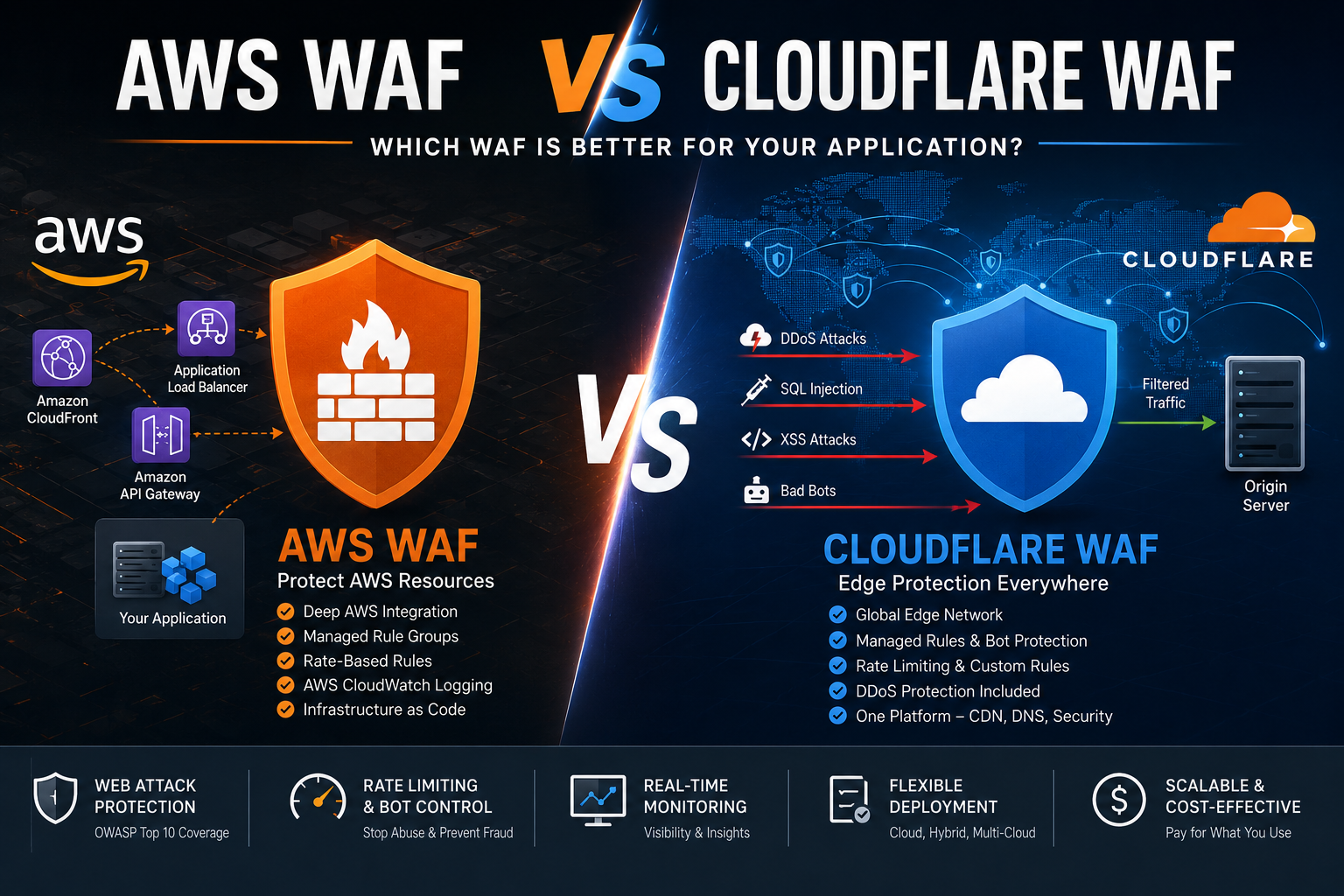
AWS WAF is the better choice when your applications already run heavily on AWS and you want tight integration with CloudFront, Application Load Balancer, API Gateway, and other AWS services. Cloudflare WAF is the stronger choice when you want an internet-facing security layer with Cloudflare’s global network, managed rules, bot controls, rate limiting, and simpler multi-provider deployment.
The key difference is architecture. AWS WAF sits naturally inside an AWS-based stack, while Cloudflare WAF sits in front of your applications as part of Cloudflare’s edge platform. Both can defend against common web attacks such as SQL injection and cross-site scripting, but their surrounding ecosystems are very different. [SOURCE: OWASP, September 2026]
For a single AWS application, I would normally choose AWS WAF. For a public website, API portfolio, or multi-cloud environment where Cloudflare is already the edge, I would usually choose Cloudflare WAF.
[IMAGE: AWS WAF vs Cloudflare WAF comparison showing AWS cloud infrastructure on one side and Cloudflare global edge network on the other]
What is the difference between AWS WAF and Cloudflare WAF?
AWS WAF is an AWS-native web application firewall designed to protect AWS resources, while Cloudflare WAF is part of Cloudflare’s edge security platform and filters HTTP/API traffic before it reaches the origin.
AWS WAF can protect Amazon CloudFront distributions and regional resources including Application Load Balancers, API Gateway REST APIs, AppSync, Cognito user pools, App Runner, and other supported AWS services. [SOURCE: AWS, September 2026]
Cloudflare WAF works through Cloudflare’s network and uses rulesets to inspect incoming web and API requests. Its rules can evaluate properties such as IP addresses, paths, headers, query strings, and request bodies. [SOURCE: Cloudflare, August 19, 2026]
That creates a useful rule of thumb:
AWS-first infrastructure → AWS WAF.
Cloudflare-first edge/security → Cloudflare WAF.
Which WAF has better protection?
For basic web application attacks, both are capable, and the quality of your configuration matters as much as the vendor.
AWS WAF supports managed rule groups from AWS and AWS Marketplace providers. AWS-managed rule groups cover common application threats, while optional products such as Bot Control and Fraud Control add more specialized protection. [SOURCE: AWS, September 2026]
Cloudflare provides managed rulesets covering known attack techniques, zero-day vulnerabilities, stolen credentials, and other application threats. Cloudflare also lets administrators customize individual managed-rule behavior through overrides and exceptions. [SOURCE: Cloudflare, August 25, 2026]
Neither WAF magically fixes insecure application logic.
OWASP makes the distinction clearly: WAFs are useful against attacks such as SQL injection and XSS, but they are less effective against vulnerabilities involving authorization and business logic. [SOURCE: OWASP Web Security Testing Guide, September 2026]
So don’t treat a WAF as a replacement for secure coding, authentication controls, dependency management, or API authorization.
Is AWS WAF or Cloudflare WAF better for AWS applications?
AWS WAF is usually the better fit for an AWS-native application.
If your architecture looks like:
Route 53 → CloudFront → ALB → EC2/ECS
AWS WAF fits directly into that architecture. You can associate a Web ACL with CloudFront and use AWS-native logging, monitoring, IAM, and automation around it. AWS also supports WAF protection for API Gateway, AppSync, Cognito, App Runner, and other AWS resources. [SOURCE: AWS, September 2026]
There is one operational detail that regularly catches people: when AWS WAF protects CloudFront, the WAF Web ACL uses the Global/CloudFront scope, which is managed in us-east-1. Regional resources use the appropriate regional scope. [SOURCE: AWS, September 2026]
That’s not a reason to avoid AWS WAF. It is simply something to account for in Terraform, IAM permissions, and deployment pipelines.
Is Cloudflare WAF better for websites and APIs?
Cloudflare WAF has a strong advantage when Cloudflare is already your reverse proxy, CDN, and DNS layer.
Instead of adding another security component inside your AWS architecture, Cloudflare can inspect traffic at the edge before requests reach your origin.
Its WAF includes managed rules, custom rules, rate limiting, security analytics, and other application-security features. Cloudflare’s current documentation also lists WAF functionality across Free, Pro, Business, and Enterprise plans, although individual capabilities vary by plan. [SOURCE: Cloudflare, August 2026]
This is particularly useful for public-facing applications where you want to combine:
- WAF rules
- DDoS protection
- Bot mitigation
- Rate limiting
- CDN caching
- Custom access rules
- Security analytics
into the same edge layer.
For an ecommerce website, for example, Cloudflare’s rate limiting can help protect login endpoints, account creation, APIs, and other abuse-prone paths. [SOURCE: Cloudflare, August 25, 2026]
AWS WAF vs Cloudflare WAF: How does rate limiting compare?
Both support rate limiting, but the implementation details differ.
AWS WAF rate-based rules count requests according to configured aggregation criteria and can rate-limit traffic when the threshold is exceeded. AWS allows aggregation by IP and supports additional aggregation-key combinations. [SOURCE: AWS, September 2026]
AWS currently supports evaluation windows of 60, 120, 300, and 600 seconds for rate-based rules. The default evaluation window is five minutes. [SOURCE: AWS, September 2026]
Cloudflare rate limiting is more tightly integrated into its Ruleset Engine. You can define an expression and characteristics used to calculate request counters. Cloudflare documents characteristics such as IP addresses and HTTP headers, with more advanced options available depending on the plan. [SOURCE: Cloudflare, August 2026]
One important warning: neither should be treated as a precision billing-style request counter. AWS explicitly says its rate-based rules do not guarantee an exact request-rate match, while Cloudflare notes that rate-limit counters can take time to update. [SOURCE: AWS and Cloudflare, September 2026]
Which WAF is easier to configure?
Cloudflare WAF is generally easier for a typical website; AWS WAF is more natural for teams already working deeply inside AWS.
Cloudflare’s current dashboard path for creating a rate-limiting rule is:
Security → Security rules → Create rule → Rate limiting rules
You then define the expression, request characteristics, threshold, and action. [SOURCE: Cloudflare, August 3, 2026]
AWS WAF revolves around Web ACLs, rules, rule groups, statements, actions, and associations with protected AWS resources.
That gives AWS WAF considerable flexibility, but it also means the learning curve is steeper for someone who has never worked with AWS security controls.
[IMAGE: Cloudflare Security Rules dashboard showing custom WAF and rate-limiting rule configuration]
Which WAF has better managed rules?
Cloudflare has the edge if you want a simple managed-rule experience; AWS WAF is excellent when you want managed rules integrated directly into an AWS security architecture.
Cloudflare’s Managed Rules are regularly updated, and the current Cloudflare Managed Ruleset covers known attack techniques and zero-day vulnerabilities. Administrators can override or disable individual rules when legitimate traffic is incorrectly detected. [SOURCE: Cloudflare, August 25, 2026]
AWS WAF similarly supports managed rule groups. AWS-managed rule groups other than certain specialized products such as Bot Control and Fraud Control are available without an additional managed-rule-group fee beyond the standard AWS WAF pricing model. [SOURCE: AWS, September 2026]
For either platform, don’t immediately put every rule into blocking mode.
Start with monitoring or counting where appropriate, examine false positives, then move high-confidence rules to Block or Challenge.
How much does AWS WAF cost compared with Cloudflare WAF?
There is no simple winner on price because the products use different pricing models and bundle different capabilities.
AWS WAF charges according to Web ACLs, rules, and web requests processed. AWS also charges separately for certain related services and optional WAF capabilities. [SOURCE: AWS, September 2026]
Cloudflare’s WAF functionality is tied to Cloudflare plans and security products. Current documentation shows that WAF features differ across Free, Pro, Business, and Enterprise, with some capabilities available as Enterprise add-ons. [SOURCE: Cloudflare, August 19, 2026]
For a small site already using Cloudflare, the economics can therefore be very attractive because WAF functionality is part of a larger edge-security stack.
For an AWS application already using CloudFront and other AWS services, AWS WAF may be the cleaner operational choice even if a simple feature-by-feature price comparison appears different.
[VERIFY] Pricing, included features, and regional charges change. Use the current AWS and Cloudflare pricing pages before publishing a cost comparison or making a purchase decision.
Can you use AWS WAF and Cloudflare WAF together?
Yes, but I would only deploy both when you have a specific security or architectural reason.
A possible architecture is:
Internet → Cloudflare → AWS CloudFront → AWS WAF → Application
This creates multiple security layers, but it also creates additional rule-management complexity.
You need to understand which system blocks the request first, how client IP information is passed, where logs are generated, and how to troubleshoot false positives.
There is another critical consideration: protect the origin.
OWASP notes that cloud WAFs can potentially be bypassed if attackers can directly reach the backend server instead of going through the WAF. [SOURCE: OWASP Web Security Testing Guide, September 2026]
If Cloudflare is supposed to be the only public entry point, don’t leave an unrestricted origin endpoint exposed.
How should you test AWS WAF vs Cloudflare WAF?
I would not judge either product using a generic “requests per second” benchmark. A better test measures detection accuracy, false positives, operational effort, and origin exposure.
Build a staging application and test:
- Normal browser traffic.
- SQL injection test strings.
- XSS test strings.
- High-frequency requests to a login endpoint.
- Large or unusual request parameters.
- Requests from deliberately blocked IP ranges.
- Legitimate API requests containing unusual characters.
- Known automated/bot traffic.
- Direct requests to the origin.
- Logging and alert visibility after each test.
For example, OWASP’s testing guidance describes using benign test payloads to determine whether a WAF blocks suspicious requests. [SOURCE: OWASP Web Security Testing Guide, September 2026]
I would record four numbers: blocked attacks, false positives, requests reaching the origin, and time required to investigate each event.
That produces a useful engineering comparison instead of a marketing benchmark.
[IMAGE: WAF testing workflow showing staging application, attack simulations, AWS WAF, Cloudflare WAF, logs, and origin server]
Which WAF should you choose?
My recommendation is simple.
Choose AWS WAF if:
- Your application is primarily hosted on AWS.
- You use CloudFront, ALB, API Gateway, or other AWS services.
- Your security team already manages AWS IAM and CloudWatch.
- You want infrastructure-as-code through tools such as Terraform or CloudFormation.
- You want WAF controls close to your AWS resources.
Choose Cloudflare WAF if:
- Cloudflare already manages your DNS/CDN.
- You operate multiple cloud providers.
- You want WAF and edge security in one platform.
- Bot and rate-limit controls are major concerns.
- You want to put the security layer in front of different origins.
Use both if:
- Cloudflare is your internet-facing edge and AWS WAF protects sensitive AWS resources.
- You have a documented defense-in-depth requirement.
- Your team can manage two rule engines without creating configuration chaos.
The worst reason to use both is simply “more security must be better.” Two WAFs with poorly coordinated rules can create false positives, debugging headaches, and a false sense of protection.
AWS WAF vs Cloudflare WAF: Quick verdict
AWS WAF wins for AWS-native environments. Cloudflare WAF wins for edge-first, internet-facing, and multi-cloud environments.
If I were protecting a new application running entirely on AWS, I would start with AWS WAF and build the rules into the infrastructure deployment process.
If I were protecting several public applications across AWS, Azure, and other hosting providers—and Cloudflare was already handling DNS and CDN—I would choose Cloudflare WAF.
The next step is not to pick the product with the longest feature list. Map your traffic path first, identify where the origin is exposed, then test both WAF configurations against the same staging application and attack cases.




