

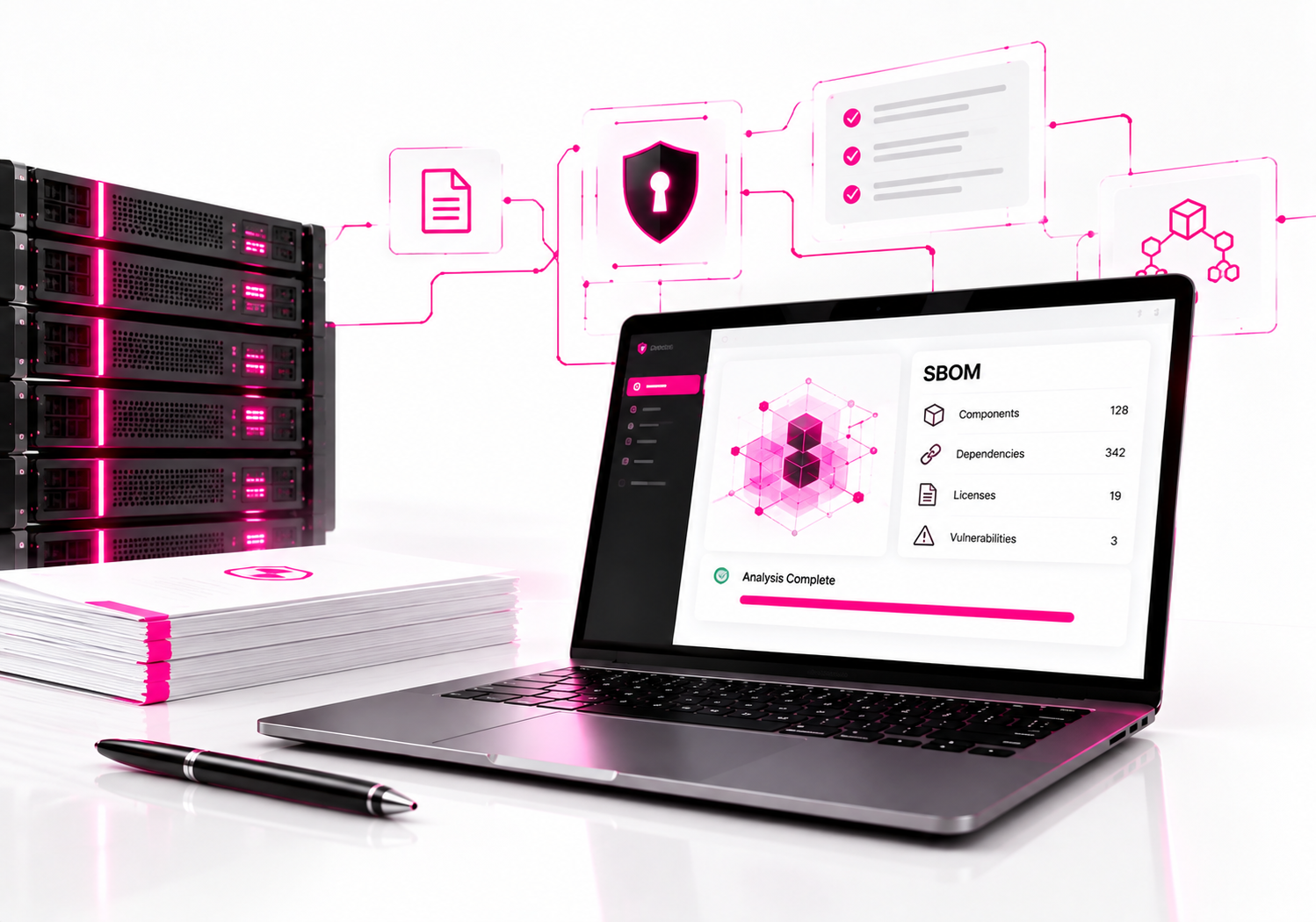
For most enterprises, Syft is the best starting point for SBOM generation because it scans containers, filesystems, source projects, and archives while producing CycloneDX, SPDX, and native JSON output. For enterprise-wide SBOM management, Black Duck, FOSSA, or Anchore Enterprise are stronger choices because they add governance, vulnerability analysis, policy, and lifecycle management.
The key distinction is between an SBOM generator and an enterprise SBOM management platform. A generator creates the inventory; a management platform stores, validates, enriches, monitors, and distributes that inventory across an organization.
That distinction changes the buying decision. A development team may only need a fast CLI that runs on every build. A large software company may need SBOMs for thousands of releases, multiple programming languages, containers, customer requests, vulnerability response, license compliance, and regulatory requirements.
This guide compares the strongest options for those different environments. It also explains which tool I would deploy first, what an enterprise SBOM must contain, and how to avoid creating a pile of static JSON files that nobody actually uses.
What is the best SBOM generator for enterprise software?
Syft is my default choice when the primary requirement is reliable SBOM generation inside CI/CD. Black Duck is a stronger choice when “generator” really means an enterprise SBOM program covering generation, management, risk analysis, and downstream reporting.
| Tool | Best fit | Main strength |
|---|---|---|
| Syft | CI/CD and engineering teams | Flexible, broad artifact scanning |
| Black Duck | Large enterprises | Enterprise SBOM lifecycle + SCA |
| FOSSA | OSS-heavy software teams | SBOM + license/compliance workflows |
| Anchore Enterprise | Container-heavy enterprises | SBOM analysis + policy enforcement |
| Microsoft SBOM Tool | Microsoft-centric environments | Scalable SPDX generation |
Syft can generate SBOMs from container images, source projects, filesystems, and archives. It supports SPDX, CycloneDX, and its own native JSON format.
Black Duck takes a broader approach. Its current platform supports enterprise SBOM generation, importing, validation, transformation, software composition analysis, license risk management, and supply-chain monitoring.
So there isn’t one universal “best” product. The right answer depends on whether you need a generator, an SBOM repository, or a complete software supply-chain security platform.
Why does an enterprise need more than an SBOM generator?
An SBOM is useful only when the organization can connect it to the software lifecycle.
The U.S. National Telecommunications and Information Administration defines an SBOM as a formal record containing details and supply-chain relationships among the components used to build software. CISA’s more recent SBOM guidance continues to emphasize standardized, machine-readable component information as a foundation for software transparency.
A mature enterprise workflow looks like this:
Build → Generate SBOM → Validate → Store → Analyze → Remediate → Distribute → Regenerate
The mistake is stopping after “Generate.”
Imagine a company releases 500 application versions in a year. Generating 500 SBOM files is easy compared with answering:
- Which production applications contain a vulnerable package?
- Which customer releases contain it?
- Which versions are affected?
- Which supplier SBOMs can be trusted?
- Which licenses apply?
- Which vulnerabilities are actually exploitable?
- What changed between two releases?
That is where enterprise SBOM management becomes valuable.
Is Syft the best enterprise SBOM generator?
Syft is one of the strongest choices for organizations that want an open-source generator embedded directly into their build pipelines.
Syft is available as a CLI and Go library and can inspect container images, source code projects, directories, archives, and other software artifacts. It also supports dozens of package ecosystems.
A basic workflow can be as simple as:
syft <image-or-directory> -o cyclonedx-json=sbom.jsonOr generate both major formats:
syft <image-or-directory> \
  -o spdx-json=sbom.spdx.json \
  -o cyclonedx-json=sbom.cdx.json
Syft’s documentation currently supports CycloneDX JSON/XML and SPDX JSON/tag-value output, alongside its native JSON format.
That flexibility is a major advantage.
Syft can also generate signed SBOM attestations using in-toto and Sigstore, allowing organizations to connect SBOM data with software supply-chain provenance.
Where does Syft fall short?
Syft is primarily a generation and cataloging tool. It does not by itself provide the complete enterprise governance layer that a large organization may need.
If your security team needs centralized portfolio management, policy enforcement, continuous vulnerability analysis, supplier SBOM ingestion, and executive reporting, pair Syft with an enterprise platform rather than expecting the CLI to do everything.
GitHub’s own documentation illustrates this model: its SBOM workflows can use Microsoft’s SBOM Tool or Anchore’s SBOM Action, which uses Syft.
Is Black Duck good for enterprise SBOM generation?
Yes. Black Duck is one of the stronger choices when SBOM generation is part of a larger enterprise software-composition and supply-chain security program.
Black Duck can generate SBOM reports at the project-version level and supports SPDX 2.2, SPDX 2.3, SPDX 3.0, and several CycloneDX versions, including CycloneDX 1.6.
That matters when different customers, regulators, or internal systems require different SBOM formats.
Black Duck also goes beyond the document itself. Its platform combines SBOM generation with open-source component discovery, vulnerability analysis, license risk management, and enterprise supply-chain visibility.
For a large organization with thousands of dependencies and multiple development teams, that broader context can be more valuable than having the fastest standalone generator.
The trade-off is complexity. If your only requirement is “generate a CycloneDX SBOM whenever a container is built,” Black Duck can be considerably more platform than you need.
Is FOSSA a good SBOM generator for enterprises?
FOSSA is particularly attractive for organizations that need SBOM generation alongside open-source license compliance, attribution, vulnerability context, and customer-facing software transparency.
FOSSA’s current documentation says its SBOM generation is available on Business and Enterprise plans. It can generate SPDX and CycloneDX SBOMs from analyzed projects or release groups.
It also provides useful content controls.
For example, FOSSA can include direct and transitive dependencies, license information, copyright data, support status, and vulnerability information. CycloneDX exports can include VEX-related vulnerability context.
That makes FOSSA a good fit when the SBOM is not just a security artifact.
A software vendor might need to provide an SBOM to a customer while also producing attribution notices and answering license questions. FOSSA brings those workflows together.
Is Anchore Enterprise good for enterprise SBOM management?
Anchore Enterprise is particularly compelling for organizations with substantial container and software-supply-chain workloads that want SBOMs tied directly to vulnerability and policy enforcement.
Anchore Enterprise can generate SBOMs from container images and filesystems, import third-party SBOMs, organize them by application and version, analyze them for vulnerabilities, and apply policy decisions against the resulting data.
This creates an important operational loop:
Artifact → SBOM → vulnerability analysis → policy → release decision
Anchore also supports importing externally generated SPDX, CycloneDX, and Syft-native SBOMs.
That means you do not have to standardize your entire organization on one SBOM generator.
For example, one engineering team could generate SBOMs with Syft while another produces them through Microsoft tooling. Anchore can ingest the resulting documents into the broader analysis workflow.
Is Microsoft’s SBOM Tool good for enterprise software?
Microsoft’s SBOM Tool is a strong choice for enterprises that want a scalable, developer-controlled generator centered on SPDX and Microsoft-oriented build environments.
Microsoft describes the SBOM Tool as a highly scalable, enterprise-ready tool for creating SPDX 2.2 and SPDX 3.0 SBOMs. It uses Microsoft’s Component Detection libraries to identify components and can incorporate license information through ClearlyDefined.
A basic generation command looks like:
sbom-tool generate \
  -b <drop-path> \
  -bc <build-components-path> \
  -pn <package-name> \
  -pv <package-version> \
  -ps <package-supplier> \
  -nsb <namespace-uri>
The tool also supports validation, aggregation, and CI/CD integration, including GitHub Actions and Azure DevOps pipelines.
The limitation is format and ecosystem focus. If your organization needs extensive CycloneDX workflows or a broad centralized SBOM-management layer, another platform may fit better.
Which SBOM format should an enterprise use?
Use the format your downstream consumers require, with SPDX and CycloneDX as the primary enterprise standards to support.
CycloneDX is maintained by OWASP and Ecma International and is designed for machine-readable software and system transparency. Its current specification supports component information, metadata, relationships, and additional supply-chain information.
SPDX is an ISO/IEC standard and is widely used for software package and license information.
| Format | Strong use case | Key advantage |
|---|---|---|
| CycloneDX | Security and supply-chain workflows | Rich security-oriented model |
| SPDX | Compliance and legal workflows | Established standardized format |
| Native formats | Internal tooling | May preserve vendor-specific detail |
Do not blindly convert SBOMs between formats.
Syft’s documentation specifically warns that conversions can lose format-specific information and recommends keeping its native JSON as the source when conversions are necessary.
The practical approach is to generate your authoritative internal record once, then export standardized formats for the systems that consume them.
What should an enterprise SBOM contain?
A useful enterprise SBOM needs much more than package names and versions.
At minimum, establish a process for capturing:
- Component name
- Component version
- Supplier or producer
- Unique identifiers such as PURLs
- Dependency relationships
- SBOM author
- Timestamp
- Software identity
- License information where relevant
- Hashes where supported
- Build or release context
- Vulnerability and VEX information where applicable
The NTIA minimum-elements work established a baseline for SBOM data, while newer CISA guidance expands practical considerations for SBOM programs.
The quality of this metadata matters.
An SBOM saying openssl 3.x is much less useful than one that clearly identifies the exact component, version, supplier, package identifier, relationship, and artifact being described.
How should an enterprise implement SBOM generation?
Generate SBOMs automatically during the build, validate them before release, store them with release metadata, and make them available to security and incident-response systems.
A practical implementation can follow these steps.
1. Define the artifact boundary
Decide what requires an SBOM.
Do not limit the program to application source repositories. Consider containers, binaries, packaged applications, desktop software, embedded components, and externally supplied software.
2. Generate during CI/CD
For a containerized application, Syft is straightforward:
syft myregistry.example.com/app:1.4.0 \
  -o cyclonedx-json=sbom.cdx.json
Generating the SBOM from the actual release artifact is important because the final artifact may contain dependencies that are not obvious from the source repository.
3. Validate the SBOM
Check the document against the expected schema and verify that required metadata exists.
Microsoft’s SBOM Tool, for example, includes a dedicated validation command for generated SBOMs.
4. Store it with the release
Keep the SBOM associated with the exact application version or artifact digest.
Do not overwrite latest-sbom.json every time a build runs.
Versioned SBOMs make incident response dramatically easier because security teams can determine what was actually shipped at a specific point in time.
5. Feed SBOMs into security analysis
Connect the SBOM to vulnerability intelligence and policy systems.
Anchore Enterprise, for example, uses SBOMs as the basis for vulnerability and policy analysis and can continuously reevaluate stored software as vulnerability information changes.
6. Make SBOM distribution part of release management
If customers or partners require an SBOM, automate the delivery process.
FOSSA, for example, supports customer-facing SBOM generation and distribution workflows.
This is much better than asking an engineer to manually find and email a JSON file after every customer request.
What should you check before buying an enterprise SBOM generator?
Ask vendors these questions before signing a contract.
| Question | Why it matters |
|---|---|
| What artifacts can it scan? | Determines actual coverage |
| Does it support SPDX and CycloneDX? | Prevents downstream compatibility problems |
| Can it run in CI/CD? | Makes generation repeatable |
| Can it import third-party SBOMs? | Essential for supplier software |
| Can it track versions over time? | Enables incident response |
| Does it support VEX? | Adds exploitability context |
| Can it enforce policy? | Connects SBOMs to release decisions |
| Can it operate at portfolio scale? | Important for large enterprises |
One question deserves special attention:
“Can I trace a component from an SBOM finding back to every affected application and release?”
If the answer requires exporting spreadsheets and manually joining data, you are looking at a generator—not a mature enterprise SBOM program.
Should enterprises use one SBOM generator everywhere?
Not necessarily. Standardize the output and governance layer rather than forcing every engineering team to use exactly the same generator.
An enterprise may use Syft for containers, Microsoft’s SBOM Tool for .NET releases, GitHub’s native SBOM capabilities for repositories, and vendor-provided SBOMs for third-party products.
GitHub currently supports exporting repository SBOMs in SPDX format and provides GitHub Actions options using Microsoft’s SBOM Tool, Syft through the Anchore SBOM Action, and CycloneDX-based dependency submission.
The better architecture is:
Multiple generators → standardized SBOMs → central management → vulnerability intelligence → policy → response
This avoids creating a single point of failure around one scanner.
What are the biggest SBOM mistakes enterprises make?
The first mistake is treating the SBOM as a compliance document instead of a live software inventory.
The second is generating SBOMs only for source repositories while ignoring final build artifacts.
The third is producing an SBOM but never connecting it to vulnerability intelligence.
The fourth is failing to track releases over time.
The fifth is accepting supplier SBOMs without validating their format, completeness, provenance, or relationship to the supplied artifact.
An SBOM program should answer a practical security question quickly:
“Where is this component deployed, and which releases contain it?”
If your tooling cannot answer that, generating more SBOMs will not solve the underlying visibility problem.
What is the best SBOM generator for your enterprise?
For a straightforward recommendation, start with Syft if your primary goal is generating high-quality SBOMs inside CI/CD. It is flexible, supports major SBOM standards, and handles a broad range of software artifacts.
Choose Black Duck when you need enterprise-scale software composition analysis and SBOM lifecycle management.
Choose FOSSA when SBOM generation is closely tied to open-source license compliance, attribution, customer sharing, and VEX workflows.
Choose Anchore Enterprise when containers, centralized SBOM analysis, vulnerability management, and policy enforcement are major requirements.
Choose Microsoft SBOM Tool when your organization is heavily invested in Microsoft development workflows and wants an enterprise-oriented SPDX generator.
For many large organizations, the best architecture will actually combine them: use specialized generators where they fit and centralize the resulting SBOMs in a management and analysis platform.
Frequently Asked Questions
What is the best SBOM generator for enterprise software?
Syft is an excellent starting point for enterprise SBOM generation because it supports containers, filesystems, source projects, archives, SPDX, and CycloneDX. Enterprises needing centralized governance, vulnerability analysis, policy, and portfolio management should consider platforms such as Black Duck, FOSSA, or Anchore Enterprise instead of relying on a generator alone.
Is Syft good for enterprise SBOM generation?
Yes. Syft is well suited to CI/CD because it can generate SBOMs from containers, source projects, filesystems, and archives and export SPDX, CycloneDX, or Syft JSON. Its open-source CLI model also makes it easy to integrate directly into build pipelines without requiring every developer to use a separate security platform.
Which is better for enterprise SBOMs, SPDX or CycloneDX?
Neither is universally better. SPDX is an ISO/IEC standard with strong adoption in compliance and licensing workflows, while CycloneDX is maintained by OWASP and Ecma and provides a rich model for software and supply-chain security. The better choice depends on the systems consuming your SBOMs; supporting both is often practical.
Can an SBOM generator detect vulnerabilities?
An SBOM generator primarily identifies software components and their relationships. Vulnerability detection normally requires a separate vulnerability-intelligence or software-composition-analysis capability. Some enterprise platforms combine generation and vulnerability analysis, but teams should distinguish the inventory-generation function from the security-analysis function.
Should an enterprise generate an SBOM for every software release?
For software subject to meaningful security, customer, regulatory, or supply-chain requirements, generating an SBOM as part of the release process is a strong practice. The SBOM should be tied to the exact artifact or release rather than treated as a continuously overwritten inventory, so responders can identify what was actually shipped.
Can an enterprise combine multiple SBOM generators?
Yes. This can be preferable to forcing every development team onto one tool. For example, different pipelines can use Syft, Microsoft’s SBOM Tool, GitHub capabilities, or vendor-generated SBOMs, while a centralized platform validates, stores, analyzes, and distributes the resulting documents.
Final Takeaway
If you need a generator, start with Syft. If you need an enterprise SBOM program, evaluate the management layer just as seriously as the generator.
The most useful SBOM is not the one with the fanciest JSON schema. It is the one that lets your security team connect a component → an application → a release → a vulnerability → an owner quickly.
The next step is to take one production application, generate its SBOM during CI/CD, validate the result, store it against the exact release, and test whether your security team can answer “where is this component deployed?” from that data alone.
