

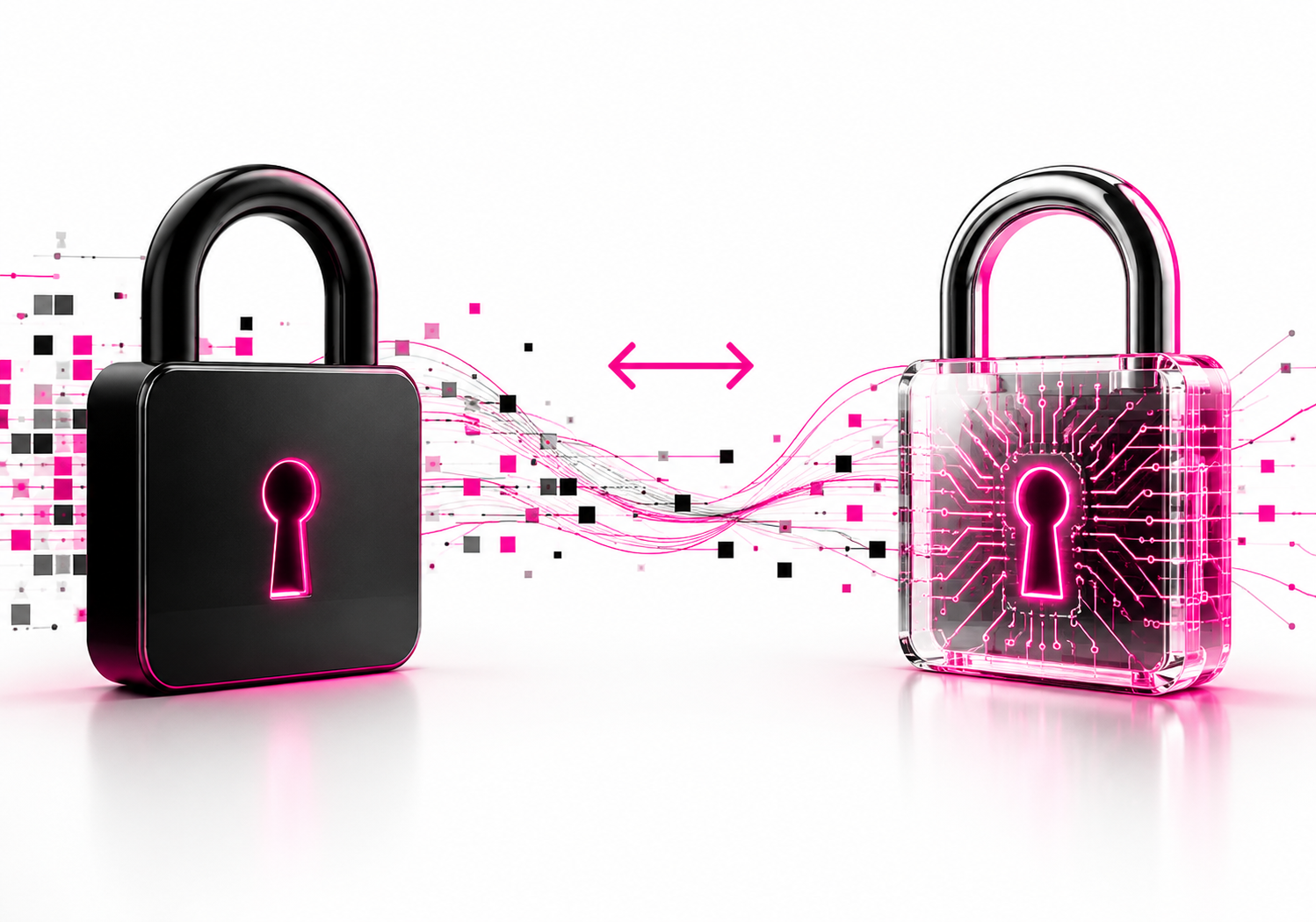
Symmetric encryption uses one secret key for encryption and decryption, while asymmetric encryption uses a related public-private key pair. Symmetric encryption is generally used for efficiently protecting large amounts of data, while asymmetric cryptography solves problems such as secure key establishment and digital signatures. Modern systems commonly combine both rather than choosing only one.
That distinction sounds simple, but it explains a huge part of how modern security systems work. AES is a common symmetric encryption algorithm, while RSA and elliptic-curve cryptography are examples of asymmetric cryptography. The two approaches have different performance characteristics, key-management requirements, and use cases.
For most applications, the real question is not “Which one is better?” It is “Where should each one be used?” HTTPS, encrypted messaging, cloud services, databases, VPNs, and other systems often use asymmetric cryptography to establish trust or exchange key material, then symmetric cryptography to protect the actual data efficiently.
What is the difference between symmetric and asymmetric encryption?
The main difference is the key structure: symmetric encryption uses the same secret key for the cryptographic operation and its inverse, while asymmetric encryption uses separate but mathematically related public and private keys. NIST defines symmetric algorithms around shared secret keying material and asymmetric cryptography around public-private key pairs.
| Feature | Symmetric encryption | Asymmetric encryption |
|---|---|---|
| Keys | One shared secret key | Public + private key |
| Typical use | Bulk data encryption | Key establishment, signatures |
| Examples | AES, ChaCha20 | RSA, ECC |
With symmetric encryption, both sides need access to the same secret key. Anyone who obtains that key may be able to decrypt protected data, depending on the system and cryptographic construction.
With asymmetric cryptography, the public key can generally be distributed openly while the private key remains secret. The two keys perform complementary operations, including encryption/decryption or signature generation/verification.
How does symmetric encryption work?
Symmetric encryption transforms plaintext into ciphertext using a secret key, and the authorized recipient uses the appropriate secret key to recover the plaintext. Because the same secret key is involved on both sides, protecting and managing that key is central to the security of the system.
A simplified model looks like:
Plaintext
   ↓
Symmetric encryption + secret key
   ↓
Ciphertext
   ↓
Symmetric decryption + secret key
   ↓
Plaintext
AES is the most familiar example. NIST’s Advanced Encryption Standard specifies AES with 128-, 192-, and 256-bit keys. In application development, however, selecting the algorithm is only part of the job; the mode, nonce or IV handling, authentication, and key management also matter.
OWASP recommends AES with at least a 128-bit key, ideally 256 bits, and recommends authenticated modes such as GCM or CCM when available.
What are common symmetric encryption algorithms?
Common examples include:
- AES — widely deployed block cipher
- ChaCha20 — modern stream cipher
- AES-GCM — authenticated encryption construction using AES
- ChaCha20-Poly1305 — authenticated encryption construction combining ChaCha20 with Poly1305
Do not confuse encryption with hashing. Passwords, for example, should normally be protected using password hashing rather than reversible encryption. OWASP explicitly advises against storing passwords using reversible encryption.
How does asymmetric encryption work?
Asymmetric cryptography uses a public key and a private key that are mathematically related but serve different roles. The public key can be distributed to other parties, while the private key must remain protected.
A simplified encryption example is:
Recipient's public key
        ↓
   Encrypt message
        ↓
     Ciphertext
        ↓
Recipient's private key
        ↓
   Decrypt message
        ↓
      Plaintext
Asymmetric cryptography also supports digital signatures, where the private key is used to create a signature and the corresponding public key is used to verify it. NIST identifies public-key cryptography as supporting both encryption/decryption and digital-signature operations.
This makes asymmetric cryptography useful when two parties need to establish secure communications without first sharing a secret key through a separate secure channel.
What are examples of asymmetric encryption?
RSA and elliptic-curve cryptography are common examples of asymmetric cryptography, but asymmetric systems also include key-agreement and digital-signature mechanisms.
OWASP currently recommends elliptic-curve cryptography using suitable modern curves such as Curve25519 for asymmetric cryptographic use cases. If RSA is required, OWASP recommends at least 2048-bit keys and appropriate randomized padding such as OAEP for RSA encryption.
Examples include:
- RSA — public-key cryptography used for encryption and signatures
- ECDH — elliptic-curve key agreement
- ECDSA — elliptic-curve digital signatures
- Ed25519 — elliptic-curve signatures
- X25519 — elliptic-curve key agreement
The terminology can get confusing because people often use “asymmetric encryption” as a general term for public-key cryptography, even when the specific operation is actually key agreement or digital signing.
Which is faster: symmetric or asymmetric encryption?
Symmetric encryption is generally much more efficient for encrypting large amounts of data than asymmetric cryptography. That is why modern protocols normally avoid using RSA or similar public-key operations to encrypt an entire large file or long network session.
Suppose you are transferring a 500 MB file. Using an efficient symmetric cipher such as AES-GCM is a practical approach for protecting the data.
Using public-key cryptography for every byte would create unnecessary computational overhead.
Instead, a modern protocol can use asymmetric cryptography to establish or protect a symmetric session key:
Asymmetric cryptography
        ↓
Establish/protect session key
        ↓
Symmetric cryptography
        ↓
Encrypt the actual data
This is the basic idea behind hybrid cryptography.
Why do modern systems use both types of encryption?
Modern secure systems combine asymmetric and symmetric cryptography because the two approaches solve different problems. Asymmetric cryptography helps establish trust and exchange key material, while symmetric encryption efficiently protects the resulting data stream.
Consider an HTTPS connection.
The browser needs to establish a secure relationship with the server. Public-key cryptography and digital signatures help with authentication and key establishment, while symmetric authenticated encryption can then protect application traffic efficiently.
This architecture gives you the advantages of both approaches without requiring public-key operations to handle all application data.
Symmetric encryption vs asymmetric encryption for key management
Symmetric encryption is simpler cryptographically but creates a key-distribution problem: every authorized party needs access to the relevant secret key. Asymmetric cryptography simplifies public-key distribution but introduces private-key protection and certificate or trust-management requirements.
For example, imagine 1,000 independent users need to communicate securely.
With a simple shared-secret design, securely distributing and maintaining many secrets can become difficult. Public-key cryptography allows users to publish public keys while keeping private keys secret.
That does not make asymmetric key management easy.
Organizations still need to manage:
- Private-key protection
- Certificate issuance
- Certificate expiration
- Key rotation
- Revocation
- Trust relationships
- Hardware security modules where appropriate
OWASP recommends formal key-management processes covering generation, storage, deployment, rotation, and decommissioning.
Which is more secure: symmetric or asymmetric encryption?
Neither is automatically more secure simply because it is symmetric or asymmetric. Security depends on the algorithm, implementation, key size, randomness, protocol, key management, and threat model.
AES-256 used incorrectly can be insecure. RSA with poor padding can be insecure. An elliptic-curve implementation with compromised private keys is also a security failure.
OWASP recommends authenticated encryption modes such as AES-GCM or AES-CCM where available and warns against insecure construction choices such as ECB in normal application use.
The practical rule is:
Choose a modern, well-reviewed cryptographic construction and use a maintained library correctly.
Do not invent your own encryption algorithm or protocol.
What are the advantages and disadvantages of symmetric encryption?
Symmetric encryption’s biggest strengths are efficiency and suitability for bulk data, while its main challenge is securely managing shared secret keys.
Advantages
- High performance
- Efficient for large datasets
- Well suited to storage encryption
- Suitable for continuous network traffic
- Mature algorithms such as AES have extensive hardware and software support
Disadvantages
- Secret keys must remain confidential
- Key distribution can be difficult
- Large numbers of communicating parties can complicate key management
- Compromising an important key can expose everything protected by it, depending on the architecture
A well-designed key hierarchy can reduce the impact of individual key compromise.
What are the advantages and disadvantages of asymmetric encryption?
Asymmetric cryptography makes public-key distribution practical and supports authentication and digital signatures, but it is more computationally demanding and requires careful private-key and trust management.
Advantages
- Public keys can be distributed openly
- Enables digital signatures
- Supports key establishment
- Useful for authentication
- Avoids requiring a pre-shared secret for every communication relationship
Disadvantages
- More computationally expensive than symmetric encryption
- Private keys require strong protection
- Certificate and trust management can become complex
- Different algorithms have different security assumptions and limitations
Asymmetric cryptography also faces a major long-term consideration: widely deployed RSA and elliptic-curve systems are not post-quantum secure. OWASP recommends considering standardized post-quantum mechanisms such as ML-KEM where appropriate for future-resistant key establishment.
When should you use symmetric encryption?
Use symmetric encryption when you need to protect data efficiently, particularly large amounts of data at rest or in transit.
Typical applications include:
- Database encryption
- File encryption
- Disk encryption
- Backup encryption
- VPN traffic
- Application session traffic
- Cloud storage encryption
- Secure messaging payloads
For application-level encryption, AES-GCM is a common choice because it provides confidentiality and authentication together.
Do not simply select “AES” and stop there. You need to select an appropriate authenticated construction and correctly handle nonces, keys, and associated data.
OWASP specifically recommends authenticated modes such as GCM and CCM when available.
When should you use asymmetric encryption?
Use asymmetric cryptography when you need public-key authentication, digital signatures, or secure key establishment between parties that do not already share a secret.
Common use cases include:
- TLS certificates
- Digital signatures
- Software signing
- Identity systems
- Secure key exchange
- Public-key encryption
- Certificate-based authentication
A useful way to think about it is:
Symmetric cryptography protects the conversation. Asymmetric cryptography helps establish who you are communicating with and how the conversation can be protected.
That is an oversimplification of modern protocols, but it is a useful mental model.
Is HTTPS symmetric or asymmetric encryption?
HTTPS uses both asymmetric and symmetric cryptography rather than being exclusively one or the other. Public-key mechanisms are used during authentication and key establishment, while symmetric authenticated encryption protects the resulting application traffic.
The exact cryptographic handshake depends on the TLS version and negotiated cipher suite.
This hybrid design avoids the major weakness of using asymmetric cryptography for every piece of application data while still allowing clients and servers to establish secure sessions.
How should developers implement encryption safely?
Start with a well-maintained cryptographic library and choose an established authenticated-encryption construction rather than implementing cryptography yourself.
A practical checklist:
1. Define the threat model
Determine whether you are protecting:
- Data at rest
- Data in transit
- Backups
- Application secrets
- Credentials
- API tokens
- Long-term confidential information
2. Select a standard algorithm
For symmetric encryption, AES with an authenticated mode such as GCM is a common choice.
For asymmetric operations, use a modern standardized construction appropriate to the protocol and environment.
3. Protect the keys
Never hard-code production encryption keys into source code.
OWASP recommends dedicated key-management systems such as HSMs, cloud key vaults, or other secure cryptographic services when appropriate.
4. Handle nonces and IVs correctly
Authenticated encryption modes commonly have strict nonce requirements. Let established libraries handle these values where possible rather than creating your own randomness scheme.
OWASP recommends secure random generation and proper IV/nonce handling.
5. Plan key rotation
A secure architecture needs a way to replace compromised or retired keys.
NIST’s key-generation guidance treats cryptographic keys as managed security assets rather than values that can simply be generated once and forgotten.
6. Separate keys from encrypted data
Where practical, store key material separately from the data it protects.
OWASP recommends separating encryption keys and encrypted data and describes data-encryption-key and key-encryption-key architectures for this purpose.
Symmetric vs asymmetric encryption: which should you choose?
For most applications, you should not choose only one. Use symmetric encryption for bulk data and asymmetric cryptography for authentication, signatures, or key establishment when those functions are required.
| Requirement | Typical approach |
|---|---|
| Encrypt large amounts of data | Symmetric |
| Digital signatures | Asymmetric |
| Establish a shared session secret | Asymmetric/key agreement |
| Encrypt application traffic | Symmetric |
| Public-key authentication | Asymmetric |
The exact design depends on the protocol and threat model, but hybrid cryptography is the normal architecture for many modern secure systems.
Frequently Asked Questions
Is symmetric encryption better than asymmetric encryption?
Neither is universally better. Symmetric encryption is generally more efficient for protecting large amounts of data, while asymmetric cryptography is useful for public-key authentication, digital signatures, and key establishment. Modern systems commonly combine both, using asymmetric mechanisms to establish trust or keys and symmetric encryption for the actual data.
Is AES symmetric or asymmetric?
AES is a symmetric encryption algorithm. It uses secret key material for encryption and decryption and is widely used for protecting data at rest and network traffic. AES-GCM is a common authenticated-encryption construction because it provides confidentiality and integrity together when implemented with correct key and nonce handling.
Is RSA symmetric or asymmetric?
RSA is an asymmetric public-key cryptographic algorithm. It uses a public-private key pair and can support encryption and digital signatures. For RSA encryption, secure padding such as OAEP is important; OWASP recommends RSA keys of at least 2048 bits when RSA is required.
Why is asymmetric encryption slower?
Asymmetric cryptographic operations rely on mathematical operations that are generally more computationally expensive than symmetric encryption operations. Their purpose is also different: asymmetric cryptography provides capabilities such as key establishment and digital signatures, while symmetric algorithms are optimized for efficient processing of bulk data.
Does HTTPS use symmetric or asymmetric encryption?
HTTPS uses both. TLS uses public-key cryptography and certificates for authentication and key establishment, then uses symmetric authenticated encryption for application data. This hybrid design combines the practical key-management advantages of asymmetric cryptography with the performance of symmetric encryption.
Can symmetric and asymmetric encryption be used together?
Yes. Combining them is a standard approach. A system can use asymmetric cryptography to authenticate parties or establish a session key, then use symmetric encryption to protect the actual data. This approach avoids using computationally expensive public-key operations for every byte of a large data stream.
Related reading: ChaCha20 vs AES-256 and PBKDF2 vs Argon2id. Browse all our cybersecurity comparisons.
Final Verdict: Symmetric Encryption vs Asymmetric Encryption
Symmetric and asymmetric encryption are complementary technologies, not competing replacements. Symmetric encryption is the workhorse for bulk data because it is efficient. Asymmetric cryptography handles public-key operations such as authentication, signatures, and key establishment.
For a new application, don’t start by asking which category is “more secure.” Start with the threat model, then use established protocols and libraries that combine the appropriate cryptographic primitives.
Next step: audit your application’s current encryption design and identify exactly where symmetric keys, asymmetric keys, certificates, nonces, and key-management systems are being used.




