

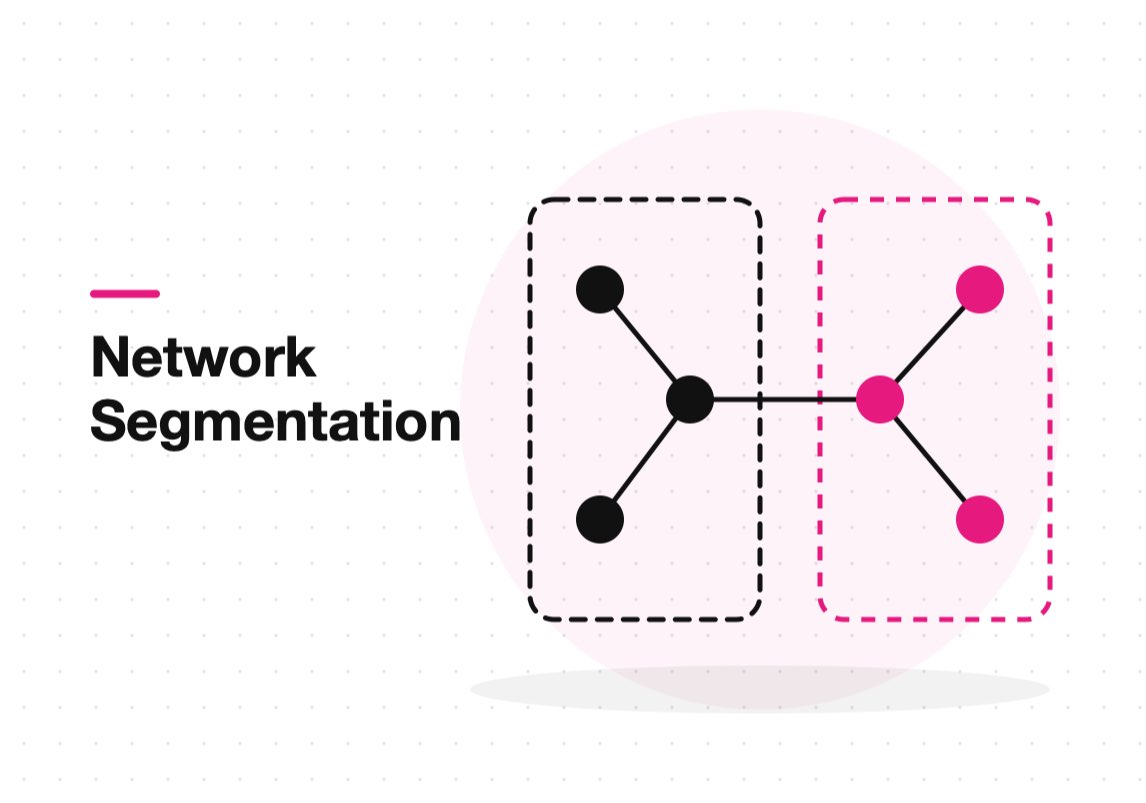
Quick answer: Network segmentation divides a network into large zones using VLANs, subnets, and firewalls, and mainly controls traffic entering or leaving each zone. Microsegmentation applies policy to individual workloads and applications, controlling traffic between systems inside the same zone. Segmentation is the foundation; microsegmentation is the finer layer that stops lateral movement.
Once an attacker lands on one machine, the next step is to move sideways toward valuable systems. Both approaches limit that movement, but at different levels of detail. This guide compares network segmentation vs microsegmentation and explains when to use each in 2026.
Network segmentation vs microsegmentation compared
| Criteria | Network segmentation | Microsegmentation |
|---|---|---|
| Granularity | Zones, VLANs, and subnets | Individual workloads and applications |
| Traffic controlled | North-south, between zones | East-west, inside zones |
| Enforcement | Firewalls, routers, and ACLs | Host agents, hypervisors, or cloud controls |
| Policy based on | IP addresses and ports | Identity, labels, and application context |
| Effort to deploy | Moderate, well understood | Higher, requires traffic mapping |
| Best at stopping | Broad access between environments | Lateral movement and ransomware spread |
The table shows that the two methods are complementary. Segmentation gives coarse separation at low cost. Microsegmentation adds precise control where a breach would hurt most. Most organizations need both, applied in that order.
What is network segmentation?
Network segmentation splits a network into separate zones, such as user devices, servers, guest Wi-Fi, and payment systems. Firewalls between zones decide what may pass. It is a long-established control, required by standards such as PCI DSS to reduce the scope of sensitive environments.
Its weakness is what happens inside a zone. Systems in the same VLAN can usually talk freely, so one compromised server can reach its neighbors. Firewall choice matters here, as covered in stateful vs stateless firewalls and packet filtering vs deep packet inspection.
What is microsegmentation?
Microsegmentation enforces policy at the workload. Each server, container, or virtual machine is allowed to communicate only with the specific systems it needs. Policies follow the workload wherever it runs. Products in this category include Illumio and Akamai Guardicore Segmentation.
It is a central element of zero trust. NIST SP 800-207 describes microsegmentation as one of the main ways to implement a zero trust architecture.
When to use each
- Use segmentation to separate environments: production from development, IT from operational technology, and guests from staff. Industrial networks should follow the zones and conduits model.
- Use microsegmentation around crown-jewel applications, databases, and domain controllers.
- Use both for connected devices, as explained in zero trust architecture for IoT.
Actionable recommendations
- Draw your current zones and list which can reach which.
- Close flat networks first. Separate user devices from servers.
- Map application traffic for two to four weeks before writing microsegmentation rules.
- Start microsegmentation in monitor mode, then enforce on your most critical application.
- Pair it with detection from network and host IDS and containment through endpoint isolation.
For the wider strategy, read NIST Zero Trust vs Google BeyondCorp and SASE vs SSE. To understand the threat this control contains, see our ransomware guide. CISA’s Zero Trust Maturity Model offers a staged roadmap.
Frequently asked questions
Is microsegmentation better than network segmentation?
It is more precise, not a replacement. Network segmentation provides broad separation, and microsegmentation adds fine-grained control inside each segment.
Does microsegmentation require agents?
Often, but not always. It can be enforced by host agents, by the hypervisor, by cloud security groups, or by network devices.
Do VLANs count as microsegmentation?
No. VLANs are a form of network segmentation. Devices in the same VLAN can normally still communicate with each other.
Does microsegmentation stop ransomware?
It does not prevent the first infection, but it sharply limits how far ransomware can spread from the first compromised machine.
Conclusion
Network segmentation vs microsegmentation is a matter of resolution. Build clear zones first, then apply microsegmentation where the impact of a breach is highest. The goal is the same in both cases: make one compromised system a contained incident instead of a company-wide one.




